Which country is best for Nigerians to study? The Ultimate Guide
Every week, I have students sitting in my office, eager to take their education overseas, and they almost always start with the exact same question. They ask, “Which country is best for Nigerians to study?” It is a massive life decision that requires balancing your family’s budget, your career ambitions, and the sheer logistics of moving across the globe. Over my years of mentoring and guiding students through this maze, I have realized that there is no single magical destination that works for everyone. Instead, there is a perfect destination for your specific situation.
I want to break down exactly what you need to know about the top global education hubs. My goal is to help you cut through the marketing noise and look at the realistic academic, financial, and immigration pathways available to you right now.

Which country is best for Nigerians to study?
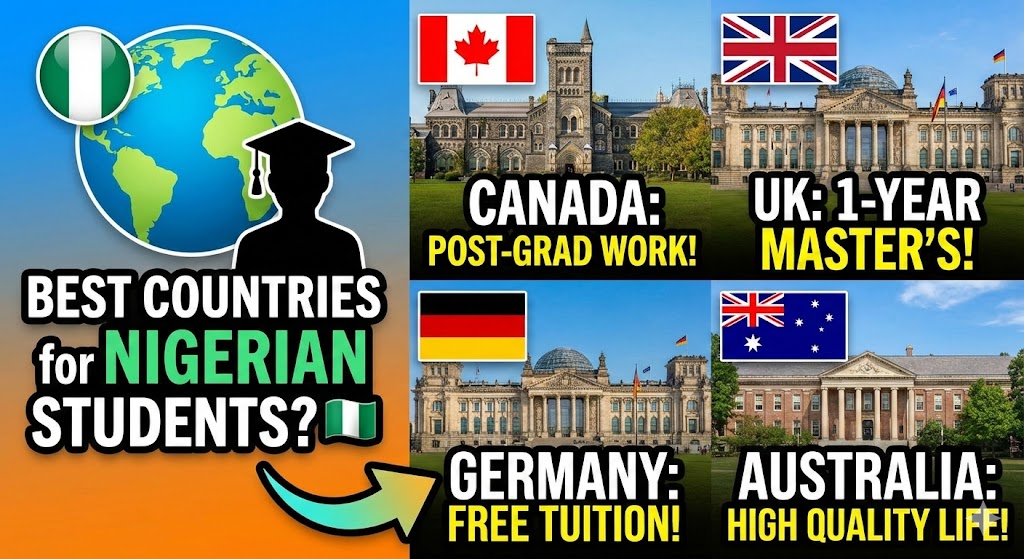
Determining the absolute best country for Nigerian students depends heavily on your specific goals, budget, and long-term career aspirations. However, Canada, the United Kingdom, Germany, and Australia consistently rank as the top choices due to their post-study work opportunities, vibrant Nigerian communities, and world-class academic institutions.
When I help students map out their future, I always tell them to look beyond the university ranking. You must consider the immigration policies of the host country, the availability of part-time jobs, and the local cost of living. Let us explore the strongest contenders.
Why is Canada highly recommended for Nigerian scholars?
Canada remains a premier destination for Nigerian scholars due to its straightforward pathways to permanent residency and high-quality education. The Post-Graduation Work Permit allows graduates to gain valuable Canadian work experience for up to three years, making it an excellent long-term investment for ambitious international students.
Canada is practically built on immigration, and they view international students as the ideal future citizens. The educational quality is universally respected, and the environment is incredibly welcoming.
However, one unique insight I always share with my students is regarding the admissions strictness. If you hold a Higher National Diploma (HND) or a lower second-class degree (2:2), direct entry into a Canadian master’s program can be exceptionally frustrating. Instead of beating your head against a wall, I recommend looking into Post-Graduate Certificate (PGCert) programs. These one-year courses are highly respected in Canada, much easier to get into, and still qualify you for competitive work permits.
What are the financial requirements for studying in Canada?
To study in Canada, Nigerian students must prove they have sufficient funds to cover their first year of tuition plus living expenses. The Canadian government requires international students to show access to a minimum baseline of funds, usually through bank statements, scholarships, or a sponsor’s financial guarantee.
You must be meticulous with your proof of funds. I always advise my students to review the official Government of Canada Study Permit guidelines well before applying. The visa officers look for history and stability in your bank statements, not just a sudden, unexplained lump sum.
How does the United Kingdom compare for Nigerian graduates?
The United Kingdom offers an exceptional academic pedigree and an accelerated timeline for Nigerian students. Most master’s degree programs take only one year to complete, saving tuition and living costs. Additionally, the Graduate Route visa allows international students to remain and work for two years post-graduation.
Many students gasp when they see the conversion rate for the British Pound. It looks intimidating. But here is the secret ROI (Return on Investment) advantage of the UK system: time. Because a standard UK Master’s degree takes just 12 months, you are paying for one less year of housing, food, and tuition compared to the two-year programs standard in North America. More importantly, you enter the global workforce a full year earlier, allowing you to start earning a professional salary while your peers elsewhere are still sitting in lecture halls.
Can I study in the UK without writing the IELTS?
Yes, many universities in the United Kingdom allow Nigerian applicants to bypass the IELTS exam. Because English is Nigeria’s official language, institutions frequently accept a minimum credit grade in WAEC or NECO English language examinations as sufficient proof of your linguistic proficiency for direct academic admission.
This is a massive relief for many. Just ensure your WAEC certificate is relatively recent, or be prepared to have your university issue a brief internal language assessment instead.
Is Germany a smart choice for budget-conscious students?
Germany stands out as the ultimate destination for budget-conscious Nigerian students because most public universities charge zero tuition fees. Students only pay a minimal semester contribution. Combined with a thriving economy and an eighteen-month job seeker visa after graduation, Germany provides unparalleled return on educational investment.
I cannot stress this enough: free education is real, and it is spectacular. You can access resources via the DAAD (German Academic Exchange Service) to find hundreds of programs taught entirely in English. You do not need to be fluent in German to study there, though learning the language locally will drastically improve your post-graduation job hunt.
How does the German blocked account system work?
International students from Nigeria must open a German blocked account to secure their student visa. This specialized bank account requires you to deposit your estimated annual living expenses upfront. Once you arrive in Germany, you receive fixed monthly payouts to ensure you can support yourself comfortably.
While coming up with roughly €11,000 upfront sounds daunting, I teach my students to reframe this. The “Sperrkonto” is actually a brilliant forced-savings mechanism. It completely shields you from Naira exchange rate fluctuations during your first year. Your money is locked in Euros and guaranteed to be there for your rent and groceries every single month, entirely removing the stress of waiting for delayed funds from home.
What essential steps guarantee a successful study abroad application?
Securing your admission and visa requires strategic planning and early preparation. You must carefully research university entry requirements, prepare outstanding statement of purpose essays, secure strong academic references, and organize your financial documentation well in advance to avoid the common pitfalls that delay Nigerian student applications.
Here is my core methodology for ensuring your success:
-
Start 12 Months Early: Do not wait until the last minute. The best scholarships and accommodation spots disappear quickly.
-
Audit Your Profile: Honestly assess your degree class and transcript. If you have a 2:2, target pathway programs or pre-masters courses rather than applying to Ivy League equivalents and getting rejected.
-
Master the Statement of Purpose (SOP): Your SOP should not be a sob story. It must be a professional pitch. Tell them exactly why their specific program bridges the gap between your past experience and your future career in Nigeria or globally.
-
Secure verifiable financial proof: As discussed, your bank statements must be unshakeable.
What are the best alternative study destinations to consider?
Alternative study destinations like Ireland, Malaysia, and New Zealand provide fantastic opportunities for Nigerian students seeking less competitive visa environments. These countries offer globally recognized degrees, affordable living conditions, and targeted pathway programs tailored for international students who might not meet strict North American entry requirements.
If you are looking at which country is best for Nigerians to study, do not sleep on Ireland. It has become a massive European tech hub, housing the headquarters of Google and Apple, making it a goldmine for IT and business graduates.
Choosing where to study is a journey of matching your personal ambition with a country’s practical realities. Weigh your options, prepare your documents meticulously, and take that bold step toward your global education.



One Comment