What Is National Symbol? Definition, Examples and Importance
What Is National Symbol? Definition, Examples and Importance
Let’s be honest, this topic is one of the easiest ways to score free marks in your Social Studies or Civic Education exams. Yet, I see students fail it every year because they mix up the meanings. Whether you are preparing for your Junior WAEC (BECE) or just copying notes for your C.A. test, you need to understand this clearly.
In this lesson, we will break down what is national symbol, look at the major ones we have in Nigeria, and explain why they matter.

Definition of National Symbols
A national symbol is an object, sign, or emblem that represents a country and differentiates it from other nations of the world. Just like your surname tells people which family you belong to, a national symbol tells the world which country a person or object belongs to.
Think about your school uniform. When you wear it, nobody needs to ask which school you attend; the uniform speaks for you. That is exactly what a national symbol does for a country. It is a mark of identity.
Examples of Nigeria National Symbols
There are several key symbols that represent the Federal Republic of Nigeria. You must know these by heart because they appear frequently in exam objective questions.
The Nigerian National Flag
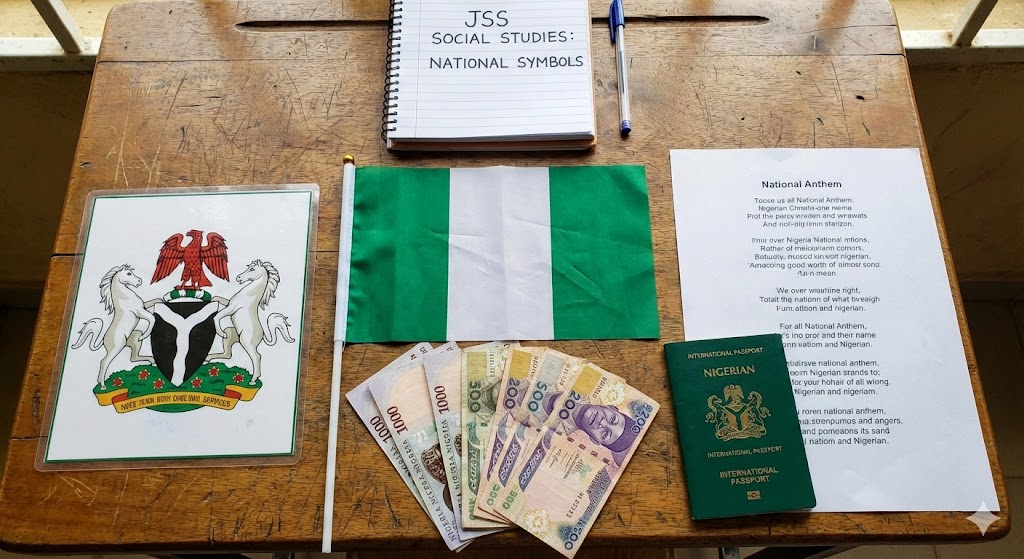
The Nigerian flag is a rectangular piece of fabric with three vertical bands of Green, White, and Green. It was designed by Pa Michael Taiwo Akinkunmi in 1959 and was officially hoisted on October 1, 1960.
-
Green: Represents Nigeria’s agriculture and natural wealth.
-
White: Represents peace and unity.
The Nigerian Coat of Arms
The Coat of Arms is the official seal of authority of the Nigerian state. It is much more detailed than the flag and tells a story about our geography and values.
Here is the breakdown you should write in your note:
-
The Black Shield: Represents the fertile soil of Nigeria.
-
The White ‘Y’ Shape: Represents the confluence of the River Niger and River Benue (where they meet at Lokoja).
-
The Red Eagle: Represents the strength of our nation.
-
The Two White Horses: Represent the dignity of Nigeria.
-
The Costus Spectabilis (Flower): This is the national flower, representing the beauty of the nation.
-
The Motto: “Unity and Faith, Peace and Progress.”
You can read more about the history of this emblem on Wikipedia’s Coat of Arms page.
The National Anthem and Pledge
The National Anthem is the official song of the country that expresses our love and loyalty to Nigeria. We recently reverted to the old anthem, “Nigeria, We Hail Thee,” but for years we sang “Arise, O Compatriots.”
The National Pledge is a solemn promise every citizen makes to be faithful to the country. I always tell my students that reciting these words without acting on them is a waste of time. You must mean what you say.
The Nigerian Currency
The currency is the legal tender used for trade and exchange of goods within Nigeria. Our currency is the Naira (₦) and Kobo (k). It was introduced in 1973 to replace the colonial Pound Sterling.
The Central Bank of Nigeria (CBN) manages this symbol. You can check the current designs on the CBN official website.
The National Passport
The Nigerian international passport is an official document issued by the government to certify a citizen’s identity for travel. Without this, you cannot legally enter another country as a Nigerian. It is your global ID card.
Importance of National Symbols in Nigeria
National symbols are not just decorations; they serve vital functions in the life of a nation.
-
Promotion of Unity: They bring people of different tribes (Hausa, Igbo, Yoruba, Ijaw, etc.) together under one umbrella.
-
Identification: They identify Nigeria among other nations. For example, at the Olympics, the Nigerian flag tells everyone who our athletes represent.
-
Authority: They show the presence of government power. That is why you see the Coat of Arms in every court and government office.
-
History: They remind us of our past, our agriculture, and our rivers.
How to Respect National Symbols
It is a crime to disrespect our national symbols. As a student, here is how you show respect:
-
Stand Still: When the National Anthem is being sung or played, you must stand at attention. Do not walk or chew gum.
-
Handle Currency with Care: Do not spray money at parties, squeeze it, or write on it. This is “abusing the Naira.”
-
Flag Etiquette: A torn or faded flag should never be flown. It should be lowered and changed immediately.
Conclusion
Understanding what is national symbol is the foundation of being a good citizen. These objects define who we are. So, the next time you see the green-white-green flag or hold a Naira note, remember that you are holding a piece of Nigeria’s identity.
Study the colors of the flag and the meaning of the Coat of Arms components thoroughly—those are the most common exam questions! Good luck.