What is Metallic Bonding? Complete Chemistry Notes for JAMB
What is Metallic Bonding? Complete Chemistry Notes for JAMB
Does the topic of Chemical Bonding always give you a headache when you open your Ababio textbook? You are not alone. Many students find it easy to understand Ionic and Covalent bonds, but when it comes to the metallic bond definition in chemistry, they get confused.
But here is the truth.
This is actually one of the simplest topics in SS2 Chemistry. If you can understand how a market works, you can understand this bond. In this lesson, we are going to break it down exactly how WAEC and JAMB set it, so you can stop cramming and start understanding.
Definition of Metallic Bonding
A metallic bond is the strong force of attraction between free-moving delocalized electrons and positively charged metal ions. This bond holds the atoms of a metal together in a crystal lattice.
Let’s break that grammar down.
In a metal (like Copper or Iron), the atoms do not keep their outer electrons to themselves. Instead, they release these electrons into a common pool. Because the atoms have lost negative electrons, they become positively charged ions (cations). The attraction between these positive ions and the “cloud” of negative electrons is what we call a metallic bond.
Think of it like “Community Glue.” The electrons don’t belong to one person; they belong to everybody, and that sharing keeps the whole community tight.
The Electron Sea Model
The Electron Sea Model is a theory that describes a metal as a lattice of positive ions submerged in a “sea” of mobile valence electrons.
This is the standard explanation you will see in [INSERT EXTERNAL LINK TO BRITANNICA/WIKIPEDIA]. But let me explain it using a Nigerian context so it sticks in your brain forever.
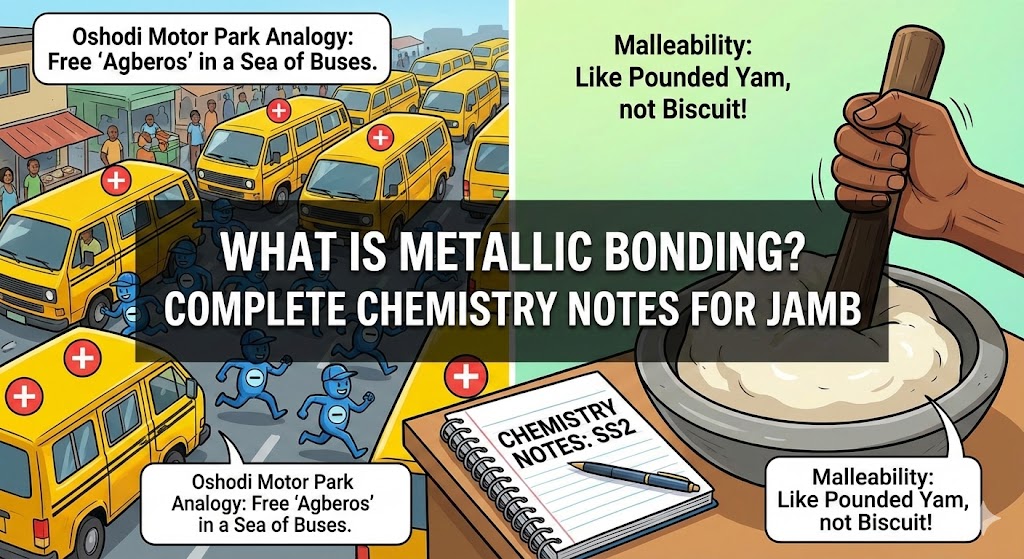
The “Oshodi Motor Park” Analogy: Imagine a busy motor park like Oshodi or Jabi Park.
-
The Danfo Buses are the Positive Metal Ions. They are heavy, they are packed together, and they don’t move around much (they just vibrate in their parking spot).
-
The Agberos (Touts) are the Delocalized Electrons. They are running everywhere between the buses. They don’t belong to one specific bus; they service the whole park.
Because the “Agberos” (electrons) are moving everywhere, they act like a glue that holds the “Buses” (ions) together. If you apply force, the buses might shift, but the agberos will just flow around them. The park doesn’t scatter. That is exactly how a metal works.
Properties of Metals Explained by Metallic Bonding
Examiners love this section. They will ask you: “Why are metals good conductors?” or “Why are they malleable?” You must use the electron sea concept to answer.
-
Good Electrical Conductivity: Metals conduct electricity because the delocalized electrons are free to move and carry current through the structure. Think of it like gossip in a compound. If you tell one person, the news spreads instantly because people (electrons) are moving around freely.
-
High Melting and Boiling Points: Metals have high melting points because the electrostatic attraction between the positive ions and the electron sea is extremely strong. You need a lot of heat energy to break this bond. It is like trying to separate two flat plates stuck together with Super Glue—it requires serious force.
-
Malleability and Ductility: Metals can be beaten into sheets (malleable) or drawn into wires (ductile) because the layers of ions can slide over each other without breaking the bond. The electrons just flow to the new shape.
-
Naija Comparison: Think of Pounded Yam. When you punch pounded yam, it doesn’t scatter; it just changes shape. That is a metal. Compare that to a Cabin Biscuit (Ionic Compound)—if you punch that one, it crumbles into pieces. That is brittleness.
-
-
Luster (Shininess): Metals shine because the free electrons vibrate when light hits them and reflect the light back. That is why your new jewelry sparkles.
Factors Affecting the Strength of Metallic Bond
The strength of a metallic bond depends on the number of valence electrons and the size of the metal atom.
If you want to score full marks in Section B (Theory), you need to state this relationship clearly:
-
Number of Valence Electrons: The more valence electrons a metal contributes to the “sea,” the stronger the bond. For example, Aluminum (Group 3) has a stronger metallic bond than Sodium (Group 1) because Aluminum dumps 3 electrons into the pool, while Sodium only dumps 1. More glue equals a stronger bond.
-
Atomic Radius (Size): The smaller the atom, the stronger the bond. Small atoms hold onto their “sea” of electrons tightly. This is why small metals usually have higher melting points than big, bulky ones in the same group.
Comparison of Metallic and Ionic Crystals
This is the “Extra Marks” section. Most students stop at the definition, but if you want that A1, you need to know how this bond differs from the others.
-
Structure: Metallic bonds involve positive ions in a sea of electrons. Ionic bonds involve a transfer of electrons from a metal to a non-metal, creating a rigid lattice [INSERT EXTERNAL LINK TO CHEMGUIDE/SCIENCE DIRECT].
-
Conductivity: Metals conduct electricity in solid state. Ionic compounds only conduct when molten or dissolved in water. This is a common trick question in JAMB.
-
Deformation: Metals are malleable (like play-doh). Ionic crystals are brittle (like glass).
Conclusion
So, there you have it. Metallic bonding is simply about positive ions swimming in a pool of free electrons.
Don’t let the big grammar scare you. Just remember the Oshodi Park analogy and the Pounded Yam comparison. If you can remember those, you can answer any question WAEC throws at you on this topic.
Now, go and smash that exam. No shaking, you’ve got this.