What is Communication? Definition and Types Explained
What is Communication? Definition and Types Explained
Have you ever tried to send a message to your friend in class without the teacher seeing you? Maybe you used a hand signal, or you wrote on a small piece of paper. That right there is what we are talking about today.
This topic of means of communication is a standard question in Junior WAEC (BECE) and even Senior Secondary Business Studies. Whether you are answering objective questions or theory, the examiners want to know if you understand how information moves from one person to another.
I am going to explain what is communication in plain English, so you don’t need to chew your pen in the exam hall. Let’s get into it.
Meaning of Communication
Communication is the process of exchanging information, ideas, feelings, or messages between two or more people. It involves a sender, a receiver, and a medium.
Think of it like a Danfo bus conductor in Lagos. The conductor shouts “Oshodi! Oshodi!” (Sender). You stand at the bus stop and hear him (Receiver). You enter the bus to show you agree (Feedback). If the conductor keeps quiet, or if you don’t understand him, communication has failed. It is a two-way street.
Types of Communication
Communication is not just about talking. We group it into different types based on how the message is sent.
-
Oral Communication: This is communication by word of mouth. It happens when you talk to your friend, make a phone call, or listen to the radio. It is the fastest method, but there is usually no permanent record.
-
Written Communication: This involves the use of written words or symbols. Examples include letters, memos, textbooks, and newspapers. The good thing here is that you can keep it for future reference (evidence).
-
Non-Verbal Communication: This is sending messages without using words. It includes body language, gestures, and facial expressions. If your mother looks at you with “bad eye” in public, she hasn’t said a word, but you know exactly what she means.
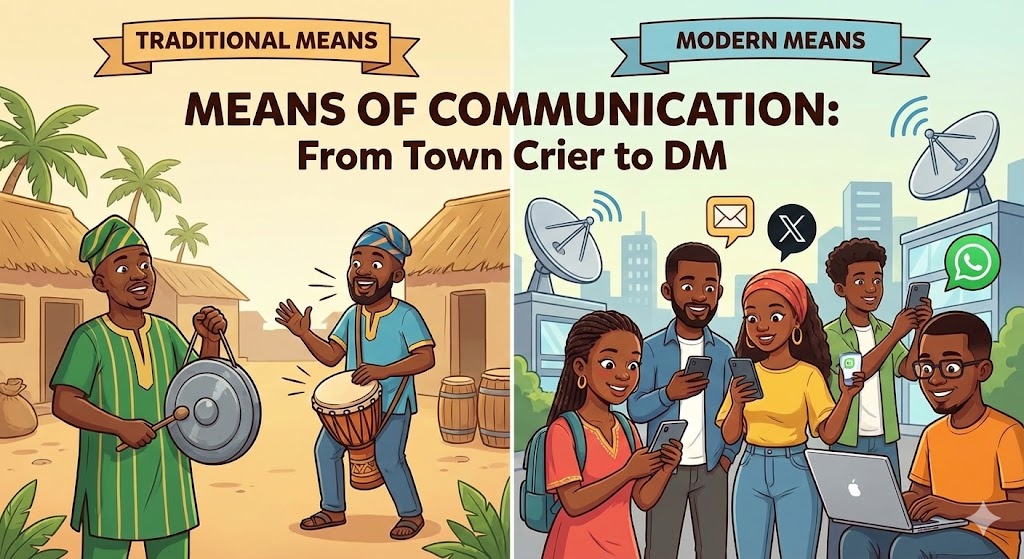
Traditional Means of Communication
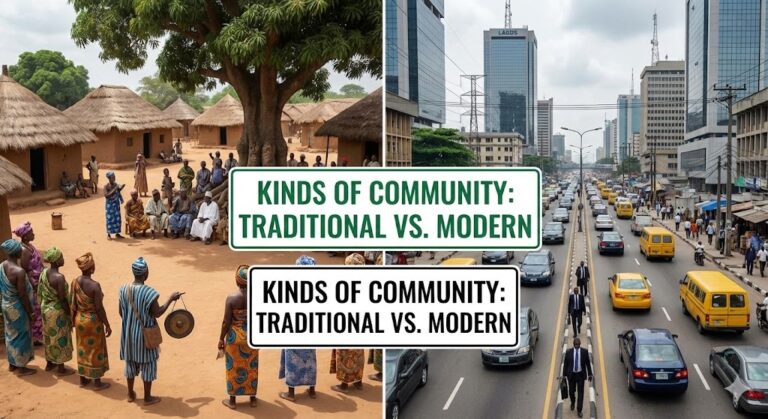
Before the white man brought phones and computers, our forefathers had their own efficient ways of sending messages. We call these the traditional media.
-
Town Crier: This was the village broadcaster. He would hit a metal gong to gather attention before announcing the King’s message. He was the manual version of a WhatsApp Broadcast list.
-
Talking Drum: In Yorubaland, the “Gangan” can mimic the tone of human speech. Expert drummers could send complex messages to neighbouring villages just by beating the drum.
-
Gun Blasts: Hunters used gunshots to signal a successful hunt or danger.
-
Palm Fronds: Placing a fresh palm frond on a piece of land or a vehicle was a sign of warning or a sacred injunction. It meant “Do Not Touch.”
Modern Means of Communication
Technology has changed the game completely. Today, the world is a “global village” because of these modern tools.
-
GSM (Global System for Mobile Communication): This is your mobile phone. It allows you to call, text, or browse anywhere in the country.
-
Email: This is the electronic post office. Instead of waiting weeks for a letter to get to Abuja, an email gets there in seconds. It is widely used in business.
-
Social Media: Platforms like Facebook, X (formerly Twitter), and WhatsApp allow instant interaction. You can read more about the impact of social media on Britannica.
-
Television: This transmits both sound and visual information to a large audience at the same time.
Importance of Communication
Why do we even bother to communicate? Why can’t we just keep quiet?
-
For Business Transactions: You cannot buy or sell without communicating. Imagine going to the market and staring at the seller without saying “How much?”
-
Bridging the Gap: It connects people who are far apart. You can talk to your uncle in London as if he is in the next room.
-
Education and Awareness: Through communication, knowledge is passed down. That is exactly what I am doing right now—communicating knowledge to you.
-
Socialization: It helps us make friends and build relationships.
Barriers to Effective Communication
Sometimes, you send a message, but the other person doesn’t get it right. These obstacles are called barriers.
-
Noise: If you are trying to talk to your friend while a loud generator is running next to you, he might hear “Rice” instead of “Price.” Noise kills communication.
-
Language Barrier: If an Igbo man speaks rapid Igbo to a Hausa man who understands only Hausa, communication has failed.
-
Poor Network: In modern times, if your signal is bad, the email won’t go. This is a technical barrier.
The “Digital Divide” Effect
Note: This is the “Extra Marks” section. Examiners love it when you mention current trends.
There is a big gap today called the Digital Divide. This is the gap between those who have access to the internet (mostly in cities like Lagos and Abuja) and those in rural villages who don’t. While you are checking your JAMB result online, someone in a remote village has to travel miles to a cyber café. Bridging this gap is a major challenge for the government, as noted by the United Nations.
Conclusion
Here is the summary: Communication is the lifeblood of society. Whether it is the Town Crier hitting a gong or you sending a DM on Instagram, the goal is the same—to pass a message.
Make sure you understand the difference between the traditional and modern means. If you can explain that clearly, A1 is sure for you.
Go and smash that exam!