What are the Six Classes of Food? (Full Explanation)
What are the Six Classes of Food? (Full Explanation)
Do you ever wonder why you feel sleepy immediately after eating a heavy plate of pounded yam in the afternoon? Or why your Agricultural Science teacher keeps shouting about “balanced diet”? This topic is a regular customer in JSS exams and even WAEC Biology.
Let’s face it. Memorizing the six classes of food can be annoying if you just try to cram everything. But you don’t need to cram. Once you understand how your body uses food like a machine, you will never forget it. I am going to break it down for you simply, so you can copy it into your notebook and get your full marks.
Meaning of Food
Food is any liquid or solid substance which, when eaten and digested, provides the body with energy and materials for growth. It is the fuel that keeps you alive.
Without food, the body is like a car without an engine—useless. We eat to get energy for work, to grow tall, and to repair tissues when we fall and injure ourselves.
The Six Classes of Food
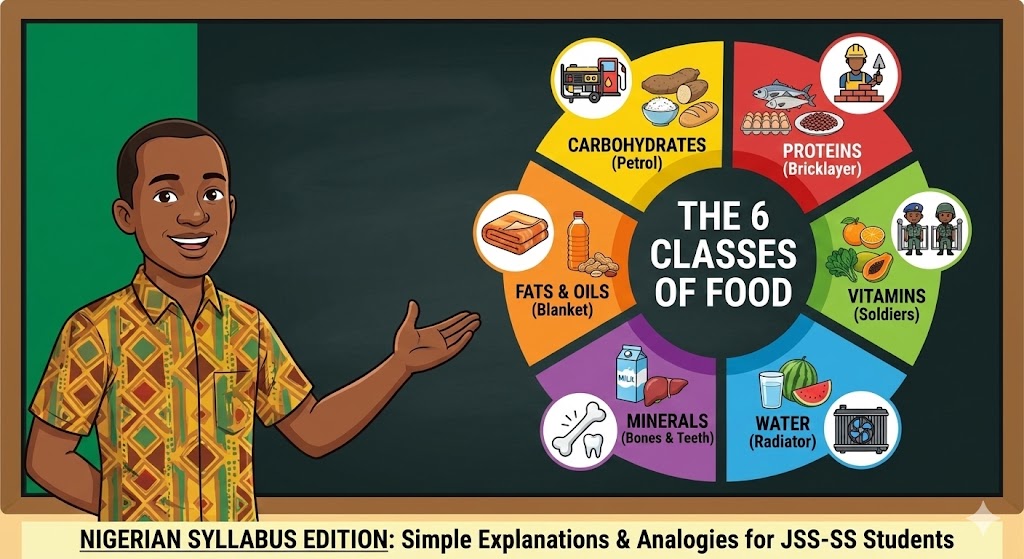
For you to be healthy, your food must contain specific chemical substances called nutrients. These nutrients are grouped into six main classes:
-
Carbohydrates
-
Proteins
-
Fats and Oils
-
Vitamins
-
Minerals
-
Water
Carbohydrates
Carbohydrates are energy-giving foods composed of carbon, hydrogen, and oxygen. They are the body’s main source of fuel.
Think of carbohydrates like petrol in a generator. If there is no petrol, the generator will cough and die. In the same way, if you don’t eat carbs, you won’t have the strength to trek to school or play football during break time. You will just be dull.
Sources:
-
Yam
-
Cassava (Garri, Fufu)
-
Rice
-
Bread
-
Maize
Proteins
Proteins are body-building foods responsible for growth and the repair of worn-out tissues. They contain nitrogen, which is not found in carbohydrates or fats.
I usually call protein the “Bricklayer” of the body. When a wall cracks, a bricklayer uses cement to patch it up. When you get a wound or a cut, protein is what your body uses to close that wound and build new skin. If you want to grow tall and strong, you cannot joke with this class of food.
Sources:
-
Beans (Cowpea)
-
Eggs
-
Fish
-
Meat
-
Milk
Fats and Oils
Fats and oils are food substances that provide more energy than carbohydrates and help keep the body warm. They are also essential for transporting certain vitamins.
While carbohydrates give you quick energy, fats store energy for later use. It acts like a blanket or sweater for your internal organs, protecting them from cold and shock. However, too much of it can lead to obesity. You can read more about healthy fat consumption on the World Health Organization (WHO) website.
Sources:
-
Palm oil
-
Groundnut oil
-
Butter
-
Margarine
-
Coconut oil
Vitamins
Vitamins are organic substances required by the body in small quantities for protection against diseases. They do not give energy, but they are vital for health.
Think of vitamins as the Soldiers or MOPOL at the gate of your house. They don’t build the house (like protein) or give electricity (like carbs), but they stop thieves (diseases) from entering. If your security is weak, sickness will enter easily.
Types:
-
Fat-Soluble Vitamins: A, D, E, K
-
Water-Soluble Vitamins: B, C
Sources:
-
Fruits (Oranges, Pawpaw)
-
Vegetables (Spinach, Ugwu)
Minerals
Minerals are inorganic elements needed for the proper formation of bones, teeth, and body fluids. Like vitamins, they are needed in small amounts but are very powerful.
For example, Calcium is what makes your bones hard. Without it, your legs would bend like rubber. Iron is needed to form blood. If you lack iron, you might feel dizzy often.
Sources:
-
Calcium (Milk, Bone)
-
Iron (Liver, Eggs)
-
Iodine (Seafood, Iodized Salt)
Water
Water is a universal solvent that helps to digest food and regulate body temperature. It makes up about 70% of the human body.
You can survive for weeks without food, but you cannot survive long without water. It acts like the Radiator Coolant in a car. If a car has no water in the radiator, the engine will knock (overheat). If you don’t drink water, your body systems will overheat and fail.
Sources:
-
Drinking water
-
Fruits like Watermelon and Orange
-
Pap and Tea
Importance of a Balanced Diet
A balanced diet is a meal that contains all the six classes of food in the correct proportions.
Eating only rice and spaghetti every day is not a balanced diet; that is “Carbohydrate Loading.” It is like wearing a very expensive suit but wearing bathroom slippers on your feet. The dressing is not complete. To be healthy, your plate must have a mix of everything—Carbs, Protein, Vitamins, and the rest.
Deficiency Diseases
Note: This is the section that gives you extra marks in theory questions.
When you lack a specific nutrient for a long time, you get a deficiency disease.
-
Kwashiorkor: Caused by lack of Protein. You see this in children with swollen bellies and thin legs.
-
Scurvy: Caused by lack of Vitamin C. This leads to bleeding gums.
-
Rickets: Caused by lack of Vitamin D and Calcium. This results in bow-legs in children.
-
Night Blindness: Caused by lack of Vitamin A. You can verify these details on Wikipedia’s Nutrition Page.
Conclusion
Don’t let the big names confuse you. Just remember: Carbs give energy (Petrol), Protein builds (Bricklayer), and Vitamins protect (Soldiers). If you remember these analogies in the exam hall, you will smile when you see the question paper.
Read your notes, eat well, and prepare hard. You will succeed.