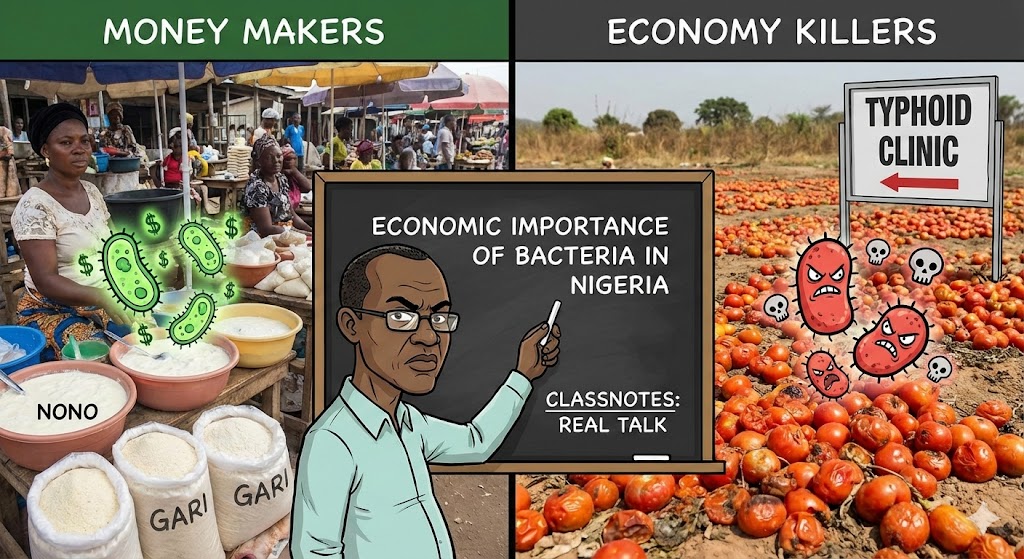
What are the Economic importance of Bacteria in Nigeria
Economic importance of Bacteria in Nigeria
Welcome to class! Sit properly, Johnson, stop dozing off.
See, yesterday I bought Nono from that Fulani woman down the street—you know the one near the school gate—and it tasted slightly sour, just the way I like it. That sour taste? It’s not magic, it’s not juju. It’s bacteria working overtime. In fact, without those tiny guys, half the food we eat in this country wouldn’t even exist, and I’m not even joking.
Textbook Definition: “Bacteria are microscopic, single-celled organisms that thrive in diverse environments. Their economic importance encompasses both their beneficial roles in industries (biotechnology, food processing, agriculture) and their harmful effects (spoilage, diseases) which impact the economy.”
beneficial-bacteria-the-invisible-money-makers
Beneficial Bacteria: The Invisible Money Makers
So, why should you care about germs that don’t make you sick?
Imagine your mother’s kitchen during a big party. You have the people cooking the Jollof, the ones washing plates, and the ones chopping onions—they are the workforce making sure the party holds. Bacteria are exactly like those kitchen assistants. Specifically in Nigeria, they are the reason we have Gari, Fufu, Ogi, and Yoghurt.
When you soak cassava for days, you think it just softens on its own? No. Bacteria are there, eating the sugar, fermenting the cassava to remove the cyanide so you don’t die after eating Eba. It’s serious business—literally, it’s an industry worth billions of Naira.
harmful-bacteria-the-economy-killers
Harmful Bacteria: The Economy Killers
But is it always good news?
Obviously not. Think of these ones as the rats that come into that same kitchen at night to steal the crayfish and spoil the soup. When bacteria attack our tomatoes in the North or spoil the milk before it gets to the market in Lagos, farmers lose money. Serious money.
If you calculate the amount of money Nigeria spends treating typhoid and cholera every year, you will shout. It’s a massive drain on our economy—money that could fix roads is going to buy antibiotics because Salmonella decided to visit.
agriculture-and-soil-fertility
Agriculture and Soil Fertility
You think fertilizer is the only way to grow corn?
There’s a bacterium called Rhizobium—don’t bite your tongue pronouncing it—that lives in the roots of groundnuts and beans. It grabs nitrogen from the air and forces it into the soil for free. Free fertilizer! If our farmers didn’t have these bacteria, the price of beans in the market would be triple what it is now. I’m telling you the truth.
The “Real Talk” Section
Listen to me. You are not learning this just to pass Biology. Nigeria is looking for entrepreneurs. If you understand how to control these bacteria, you control the food industry. People who make yoghurt, people who treat waste, people who make compost for farming—they are all just bacterial managers. You can be a billionaire just by managing germs.
Exam Corner: Cheat Sheet
5 Likely WAEC/NECO Questions:
-
List three food products in Nigeria produced using bacteria.
-
Explain the role of bacteria in the nitrogen cycle.
-
Discuss two ways bacteria cause economic loss in Nigeria.
-
Name the specific bacterium used in the production of vinegar.
-
State the difference between antibiotics and antibodies.
Model Answers (Memorize these, don’t argue):
-
Q: List three food products in Nigeria produced using bacteria.
-
A: Yoghurt (or Nono), Gari (through cassava fermentation), and Ogi (Pap).
-
Teacher’s Note: Don’t write “Bread”. That’s yeast (fungi). WAEC will fail you flat.
-
-
Q: Discuss two ways bacteria cause economic loss.
-
A: First, food spoilage: Bacteria cause the rotting of perishable crops like tomatoes and fruits during transport, leading to financial loss for farmers. Second, Diseases: Bacterial diseases like Typhoid reduce the workforce productivity and increase government spending on healthcare.
-