What Are The Differences between Mitosis and Meiosis
Welcome to class!
Sit down, sit down. Listen, I have to be honest with you—I absolutely hated this topic when I was in secondary school. I used to mix them up constantly until my Biology teacher literally knocked sense into my head with a ruler. Violent times, eh? But seriously, if you don’t pay attention now, you will cry when you see Section B of your biology exam because these two processes look exactly the same until you actually look closer at the details. It’s annoying.
What Are We Even Talking About?
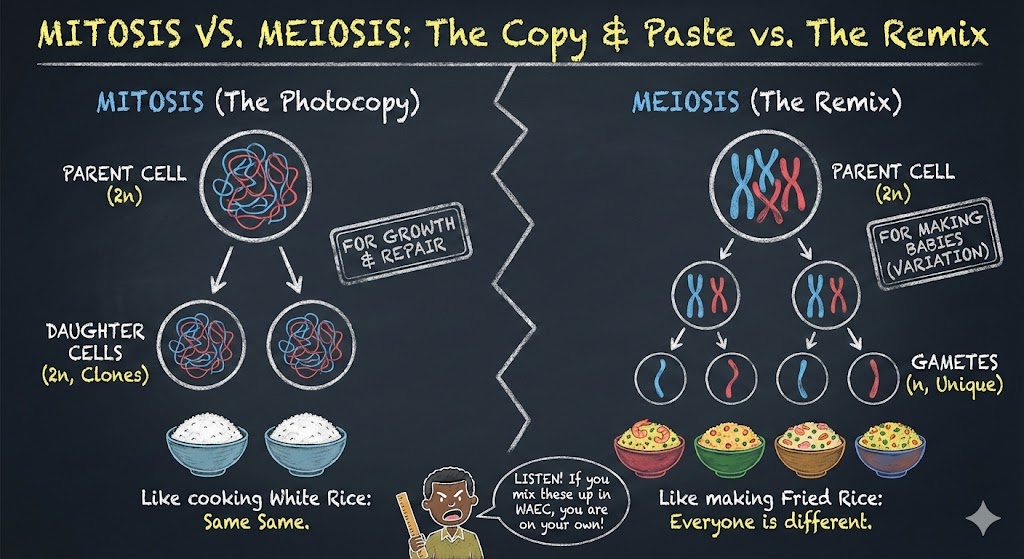
Mitosis: A type of cell division that results in two daughter cells each having the same number and kind of chromosomes as the parent nucleus, typical of ordinary tissue growth.
Meiosis: A type of cell division that results in four daughter cells each with half the number of chromosomes of the parent cell, as in the production of gametes and plant spores.
1. Where Does It Even Happen?
So, why should you care about location?
Because context is everything. Think about it—you don’t wear a wedding gown to go and buy pepper in the market, right?
Mitosis happens in your Somatic cells. That’s fancy science talk for “body cells.” Your skin, your liver, your muscles. Every time you scrape your knee playing football and it heals, that is Mitosis working overtime to replace the skin. It’s boring, routine work.
Meiosis? That’s the VIP section. It only happens in your Germ cells (sex cells). We are talking about sperm and egg production. That’s it. Nowhere else. If your liver starts doing Meiosis, you have a big problem.
2. The End Product: Clones vs. Uniques
Do you want a photocopy or a remix?
Here’s the kitchen analogy I promised.
Imagine Mitosis is like cooking a pot of white rice. You take rice from the bag, you boil it. Every spoon you take tastes exactly the same as the spoon before it. It’s consistent. It’s reliable. Mitosis produces two identical daughter cells. They are clones.
Meiosis is like making Nigerian Fried Rice. You have the rice, but then you add liver, maybe some prawns, carrots, peas, and you mix it all up. Every plate you serve might have a slightly different mix of ingredients. Meiosis produces four genetically unique daughter cells. They are not the same—this is why you and your brother don’t look like twins even though you came from the same parents.
3. The Chromosome Count
Are we keeping everything or throwing half away?
This is where WAEC likes to set traps—I’ve seen students fail this part year after year because they refuse to count.
In Mitosis, the chromosome number stays the same. We call this Diploid (2n). If the parent has 46 chromosomes, the daughter cells have 46. It’s a copy-paste job.
In Meiosis, the number is cut in half. We call this Haploid (n). If the parent has 46, the daughters have 23. Why? Think about it. If the sperm had 46 and the egg had 46, the baby would have 92 chromosomes. That’s not a human being anymore, that’s an alien. Nature is smart, so it halves the number first.
Real Talk: Why This Matters in Nigeria
Forget the exam for a second.
If you understand this, you understand life. Mitosis is why you grow tall. It’s why when you cut your finger slicing onions, the wound closes up in a few days. It is survival.
Meiosis is variation. You know how sometimes you see a family where everyone is short but one child is tall? That is Meiosis shuffling the genes like a deck of cards. It’s the reason we aren’t all robotic clones walking around Lagos looking exactly the same.
The Exam Corner
WAEC and JAMB examiners are lazy, so they recycle these questions. Memorize this.
Likely Questions:
-
State three differences between Mitosis and Meiosis.
-
Explain the significance of Meiosis in sexual reproduction.
-
Where does Meiosis occur in flowering plants? (Hint: Anthers and Ovaries).
-
If a somatic cell has 20 chromosomes, how many will the gamete have?
-
Why is Mitosis described as equational division?
Model Cheat Sheet Answers:
Q: State three differences between Mitosis and Meiosis.
-
Answer:
-
Mitosis occurs in somatic cells, while Meiosis occurs in reproductive cells.
-
Mitosis produces 2 diploid cells, while Meiosis produces 4 haploid cells.
-
Mitosis involves one division, while Meiosis involves two successive divisions.
-
Q: If a somatic cell has 20 chromosomes, how many will the gamete have?
-
Answer: 10. (Because gametes are formed by Meiosis, which halves the chromosome number).
Next class we do Genetics. Come early, don’t be late. See you.