JAMB Syllabus for Biology 2026: Official Topics, Recommended Textbooks & CBT Strategies
JAMB Syllabus for Biology 2026: Official Topics, Recommended Textbooks & CBT Strategies
Navigating the Unified Tertiary Matriculation Examination (UTME) requires more than just aggressive reading; it demands surgical precision. I’ve seen firsthand how a single mismanaged minute can unravel months of preparation. The CBT timer is unforgiving. It doesn’t care if you spent six months memorizing the intricate details of the human alimentary canal. To beat the algorithm and secure a top-tier score, you must align your study patterns directly with the official examination framework.

What is the official outline for the 2026 JAMB Biology syllabus?
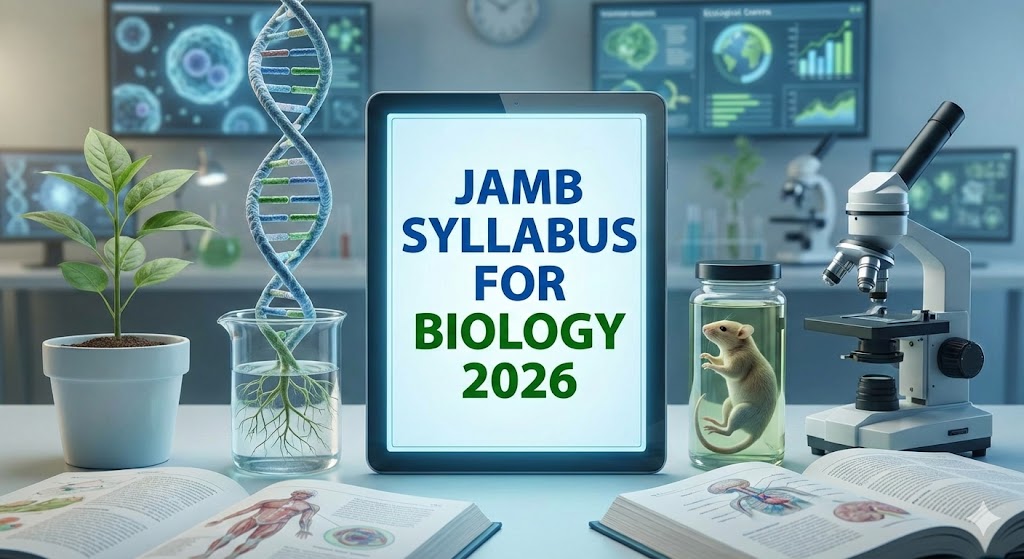
The official 2026 JAMB Biology syllabus is divided into five core modules designed to test your understanding of life sciences. These modules span from basic cellular organization to complex ecological interactions. Mastering these exact sections is the guaranteed pathway to scoring highly in your upcoming UTME computer-based test.
Which topics fall under Variety of Organisms and Form & Functions?
Sections A and B of the syllabus focus on biological diversity and anatomical structures. Candidates must understand the internal systems of both plants and mammals, alongside metabolic processes like nutrition, transport, and respiration. You will also need to grasp how these living organisms structurally adapt to survive.
To conquer these foundational sections, prioritize the following high-yield topics:
-
Cellular Frameworks: The structural differences between prokaryotic and eukaryotic cells, including organelle functions (e.g., ribosomes, mitochondria).
-
Taxonomy: Characteristics of Monera, Protista, Fungi, Plantae (Thallophyta to Angiosperms), and Animalia.
-
Internal Systems: The transport mechanisms in plants (xylem/phloem) versus the mammalian circulatory system. Reviewing Michigan State University’s detailed plant biology resources can profoundly clarify these internal botanical structures.
-
Metabolic Equations: You must be able to identify the correct chemical representations of core processes. For example, the precise stoichiometry of photosynthesis:
What are the key topics in Ecology, Heredity, and Evolution?
Sections C, D, and E examine environmental interactions and genetic continuity. You are required to understand nutrient cycling, symbiotic relationships, and local Nigerian biomes. Additionally, you must calculate Mendelian inheritance probabilities and evaluate modern evolutionary theories, including natural selection and the interpretation of fossil records.
-
Ecological Dynamics: Food chains, trophic levels, and biochemical cycles (carbon, nitrogen, and water).
-
Genetic Principles: Continuous vs. discontinuous variation, sex-linked traits, and foundational Mendelian genetics. To deeply understand chromosome mapping and genetic variation, you can review the National Human Genome Research Institute’s comprehensive guide on genetics.
-
Evolutionary Benchmarks: Differentiating Lamarck’s theory of acquired characteristics from Darwin’s theory of natural selection.
Which textbooks does JAMB officially recommend for Biology?
JAMB explicitly recommends several highly standardized textbooks to prepare for the 2026 UTME. Relying on these approved publications ensures you study the exact terminologies and structural diagrams the examiners use. Avoid outdated materials; stick to these vetted science publications to guarantee highly accurate knowledge acquisition.
-
Modern Biology for Senior Secondary Schools by S.T. Ramalingam
-
Essential Biology for Senior Secondary Schools by M.C. Michael
-
College Biology by Idodo-Umeh
-
Biology for Senior Secondary Schools by STAN (Science Teachers Association of Nigeria)
How should I allocate my time per section during the CBT?
Maximizing your UTME score requires strict time management across different biological modules. Because the exam is computer-based and strictly timed, spending too long on complex genetics questions can ruin your chances. You should systematically assign specific time limits based on the historical difficulty of each section.
Based on simulated data and candidate performance metrics, here is the optimal time-allocation strategy for a 40-question Biology paper:
Which interactive apps supplement traditional JAMB reading?
Reading textbooks alone often leaves critical knowledge gaps, especially for complex anatomical structures. Gen Z candidates are increasingly adopting interactive virtual laboratory applications to visualize abstract biological processes. These highly engaging digital tools drastically improve spatial memory and retention for the Form and Functions section.
-
Complete Anatomy: Exceptional for mapping out the mammalian internal structure, skeletal systems, and circulatory pathways.
-
Cell Explorer (3D): Perfect for zooming into microscopic environments to differentiate between the Golgi apparatus, endoplasmic reticulum, and lysosomes.
-
Virtual Punnett Square Generators: Ideal for rapidly running complex monohybrid and dihybrid cross scenarios until the mathematical probabilities become second nature.
How does JAMB use alternative terminologies to trick candidates?
Examiners frequently utilize biological synonyms to confuse candidates who rely purely on rote memorization. Understanding these alternative terminologies prevents you from missing questions where you actually know the underlying concept. Grasping this interchangeable scientific vocabulary is absolutely essential for navigating the toughest UTME questions safely.
Do not let archaic or alternative names cost you points. Memorize these frequent taxonomic and systemic swaps: