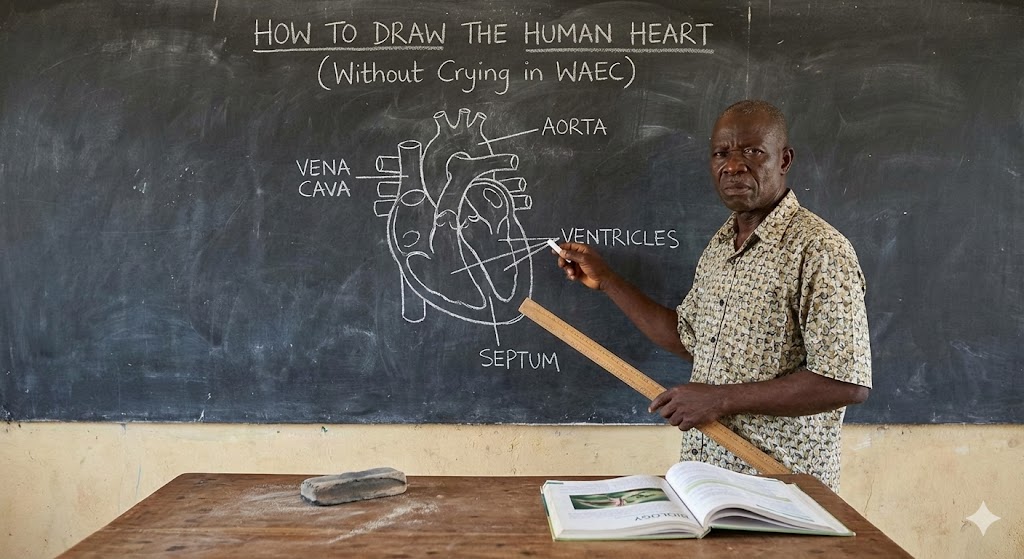
How to draw the human heart and label it correctly step by step
See, eh, put down that phone and look at me. When I saw this topic on the syllabus, I almost groaned out loud because I remember marking WAEC papers last year—it was terrible, people were drawing mangled tomatoes instead of hearts—and I swore I wouldn’t teach it again. But here we are. You have to learn it. It’s one of those questions they set just to punish students who don’t like drawing. If you don’t pay attention now, you will end up drawing a circle with tubes sticking out and begging for half marks. We are going to simplify this thing today.

What Are We Even Doing?
Diagramming the Human Heart: producing a scientifically accurate, schematic representation of the human cardiac structure, illustrating the four chambers, major blood vessels (aorta, vena cava, pulmonary artery, pulmonary vein), and valves, indicating the direction of blood flow.
Table of Contents
Toggle1. Step 1: The Main Structure (Forget Valentine)
So, why are you holding your pencil like you want to draw a Valentine card?
Listen to me, this is biology, not a romance novel. The real heart doesn’t look like that pretty emoji on your phone, it looks more like a lopsided mango or a clenched fist that has seen trouble. Seriously.
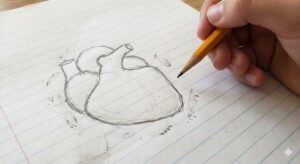
Start by drawing a tilted, rounded box, maybe slightly pointed at the bottom left. Don’t make it perfect. Nature isn’t perfect. This is just the outline, the container for everything else.
2. Step 2: The Four Chambers (The “Face-Me-I-Face-You”)
What is inside this structure?
You need to divide the house. Imagine a typical “face-me-I-face-you” apartment building in Lagos where you have rooms on one side and rooms on the other with a thick wall in the middle.
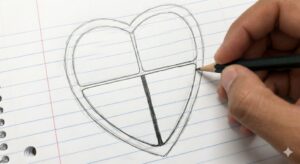
Draw a line straight down the center, but listen—stop halfway. The bottom part of this line needs to be thick, very thick. That’s the Septum. It separates the clean blood on the left from the dirty blood on the right. If that wall has a hole, you have big problems. Then draw a horizontal line across. Now you have four rooms. Four chambers. Top ones are Atria, bottom ones are Ventricles. Simple.
3. Step 3: The Major Pipes (The Plumbing)
How does the blood even move around?
You need plumbing. This is where most students get confused and start crying in the exam hall because the tubes cross over.
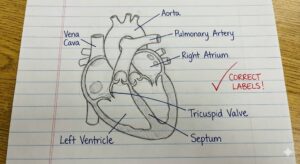
It’s basically kitchen plumbing. At the top, draw two big pipes coming out. The biggest one arching over the top like a rainbow is the Aorta—think of it as the main water tank pipe supplying the whole body. The other one next to it is the Pulmonary Artery, taking dirty blood to the lungs to get cleaned. Then you need pipes coming in—draw the Vena Cava entering the top right room. It brings used blood back from your body.

4. Step 4: The Valves and Labels (The Security Doors)
Why do we need these little flaps?
Blood isn’t allowed to flow backward. It’s a strict one-way street in there.
You need to draw little flaps between the top rooms and bottom rooms. These are the valves. They are like those security doors that only open outward; once blood passes through, they slam shut so it cannot go back up. You must label them. If you draw a beautiful Picasso painting of a heart but don’t label the Aorta or the valves, WAEC will give you zero. I’m serious, I’ve given zeros for unlabelled diagrams many times.
Real Talk: Why Nigerian Students Need This
Forget the marks for a second.
Look, cardiovascular disease is becoming a big issue in this country right now. Too much suya, too much stress, sitting in Lagos traffic for four hours every day—it takes a toll. Understanding how your own pump works is vital. Knowing that the left side of your heart is thicker because it works harder to push blood all the way to your toes might actually make you take care of yourself better. It’s your engine. You should know what it looks like.
The Exam Corner
WAEC and NECO examiners are sometimes very lazy, they repeat these questions every few years. Memorize them.
Likely Questions:
-
Draw a large, labeled diagram of the longitudinal section of the human heart. (This is the big 10-mark question).
-
Indicate by means of arrows the direction of blood flow on your diagram.
-
State one function of the tricuspid valve.
-
Why is the muscular wall of the left ventricle thicker than the right ventricle?
-
Explain why the heart is described as a double pump.
Model Cheat Sheet Answers:
Q: Why is the muscular wall of the left ventricle thicker than the right ventricle?
-
Answer: The left ventricle needs much more muscle power and pressure to pump blood to the entire body (systemic circulation), whereas the right ventricle only pumps blood just next door to the lungs.
Q: State one function of the tricuspid valve.
-
Answer: To prevent the backflow of blood from the right ventricle into the right atrium when the ventricle contracts. (Basically, it’s a one-way security door).