Difference between Homoiothermic and Poikilothermic animals
Difference between Homoiothermic and Poikilothermic animals
Welcome to class!
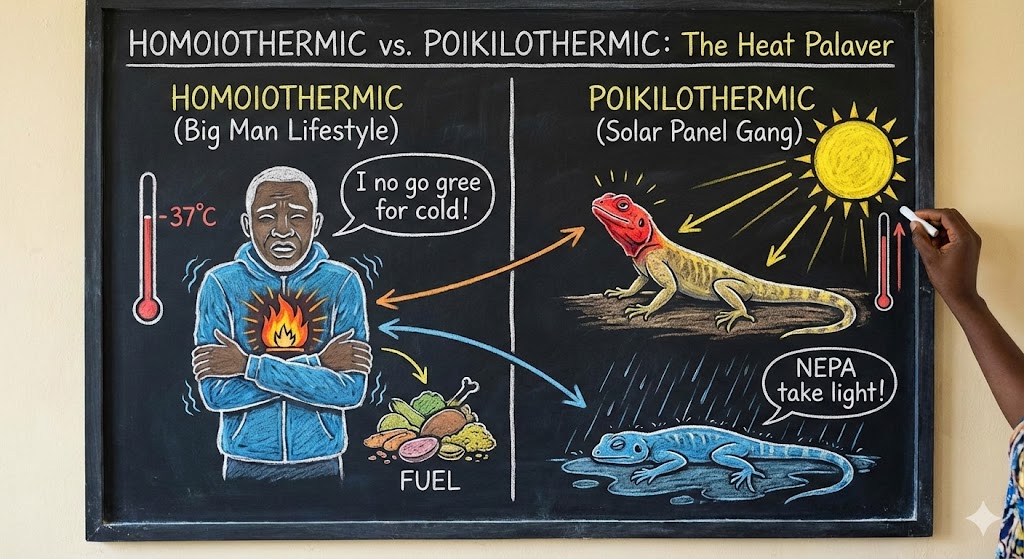
See, before you even open that notebook—I know you want to write, put the pen down—let me tell you what happened this morning. I was walking past the Principal’s office and I saw this massive male Agama lizard, the one with the red head, just doing press-ups on the wall under the scorching sun. I was sweating like a Christmas goat, fanning myself with a newspaper, wondering why this silly lizard was enjoying the heat that was killing me. That’s exactly what we’re talking about today. It’s the only reason you’re not dying of cold when the rain falls, and why that lizard disappears when the sun goes down.
Here is the textbook definition. It’s boring, but you know how WAEC markers are—if you don’t give them their exact English, they’ll mark you down.
“Homoiothermic animals are organisms that maintain a constant body temperature irrespective of the environmental temperature (Warm-blooded). Poikilothermic animals are organisms whose body temperature varies directly with the environmental temperature (Cold-blooded).”
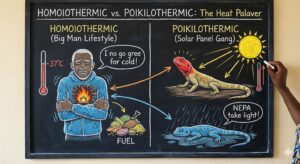
Homoiothermic Animals (The “Big Man” Lifestyle)
So, do you think it’s cheap to be a human being?
Basically, being homoiothermic means your body is like a big “I-better-pass-my-neighbor” generator that never gets switched off. You are constantly burning fuel—that Eba and Egusi you ate yesterday—just to keep your internal engine running at exactly 37°C. It doesn’t matter if you enter a freezer or you stand under the hot sun in Sokoto, your internal temperature stays the same. That’s why you shiver when it’s cold; your body is literally vibrating to generate heat because it refuses to let your temperature drop. It’s a very expensive lifestyle—I mean metabolically expensive—because you have to eat constantly to fuel that heat.
Poikilothermic Animals (The “Solar Panel” Gang)
Why do you think you never see snakes when it’s raining heavily?
These guys—fishes, amphibians, reptiles—are smart, or maybe just lazy. Think of them like a solar panel. If the sun isn’t shining, they don’t have power. They don’t waste energy trying to heat themselves up from the inside, they just wait for the environment to do it for them. If the place is hot, their body is hot and they move fast; if the place is cold, their body gets cold and they become sluggish. This is actually why a crocodile can go months without food while you get hungry if you skip lunch—they aren’t wasting energy keeping a heater on 24/7.
Real Talk: Why You Should Actually Care
Listen to me, forget the exam for a second. You need to understand this because it explains why your grandmother tells you not to pour salt on a frog—it hurts their skin because they breathe through it, but that’s for another class—it explains why mosquitoes are so annoying in the evening. Mosquitoes are poikilotherms. When it’s too hot at noon, they hide. When it cools down just a bit in the evening, they come out to bite you. Understanding this helps you know when to close your windows! Plus, when you see a lizard nodding its head, it’s not greeting you, it’s just trying to regulate its temperature.
Exam Corner
WAEC loves this topic. They bring it out every two years—I checked the past questions from 1998 till now—so don’t joke with it.
5 Likely Questions:
-
Differentiate between Homoiothermic and Poikilothermic animals using three specific headings.
-
Give three examples of Homoiothermic animals that are NOT mammals.
-
Explain why Poikilothermic animals are less active at night.
-
Why do Homoiothermic animals require more food than Poikilotherms of the same weight?
-
State one advantage of being Homoiothermic.
The “Cheat Sheet” Answers:
-
Question 1 Answer (The Table Trick): Always draw a table! Markers hate reading paragraphs.
-
Homoiotherms: Constant body temp | High metabolic rate | Examples: Birds, Mammals.
-
Poikilotherms: Varying body temp | Low metabolic rate | Examples: Fish, Reptiles.
-
-
Question 4 Answer (The Logic): “Homoiothermic animals have a high metabolic rate to generate internal heat for body temperature regulation, requiring more energy (food), whereas Poikilotherms rely on external heat.”
Next class we do Adaptation for Survival. See you.