What are the Kinds of Community? (Full Definitions and Differences)
What are the Kinds of Community? (Full Definitions and Differences)
Social Studies can be tricky because the terms look simple, but the definitions must be exact. I see students fail this section in the Junior WAEC every year, not because they don’t know what a village is, but because they cannot define it broadly.
When we talk about the kinds of community, we are looking at how human beings organize themselves. Whether you live in a quiet village in Osun State or a busy estate in Lagos, you belong to a community. This guide will break down the syllabus so you can copy the notes directly into your notebook.
Definition of Community
A community is a group of people living together in a specific geographical area who share common interests, values, and culture. It is not just a crowd of people standing at a bus stop; the members must interact and have a sense of belonging.
According to sociologists, a community acts as a social unit where humans find security. Britannica defines community as a group of people with common characteristics or interests living together within a larger society. In Nigeria, your community determines your identity. Think of it like a football team. You might all be different (goalie, striker, defender), but you wear the same jersey and fight for the same goal.
The Traditional Community
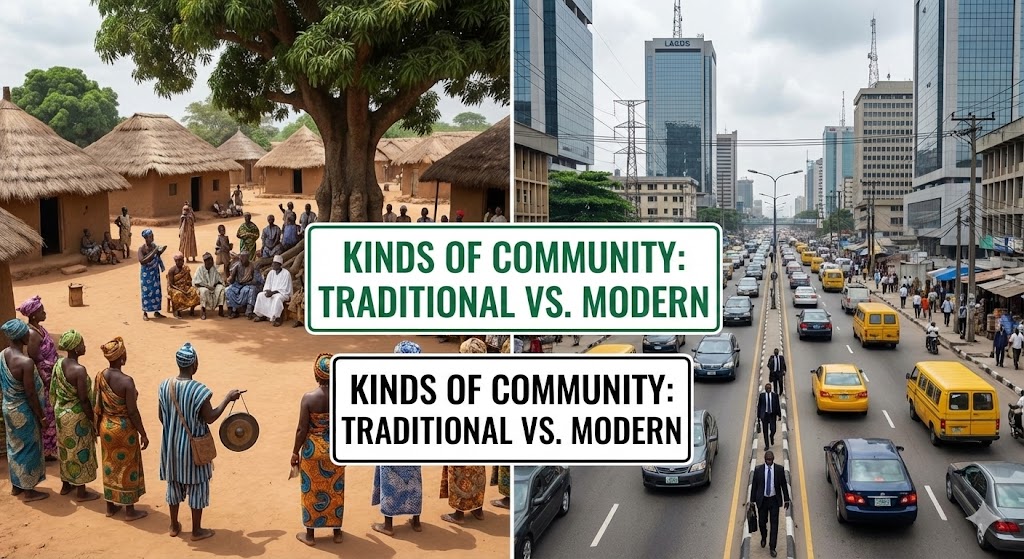
A traditional community is a social group bound by customs, long-standing traditions, and close blood ties, usually situated in rural areas. This is what we commonly refer to as the “village” setting.
In this setting, everybody knows everybody. It is small, and life is simple. I always tell my students to think of the “Village Square” meetings in Nollywood movies. In a traditional community, if you cough, your neighbor knows. Relationships are face-to-face, and the bond is very tight.
The Modern Community
A modern community is a complex society characterized by advanced technology, industrialization, and diverse populations, typically found in urban centers. This is the city life—places like Abuja, Port Harcourt, or Ikeja.
Here is the truth: modern communities are fast. People are often strangers to one another. You can live in a block of flats for two years and not know the surname of the man living next door. This is the “Mind Your Business” type of settlement. People are connected by their jobs and economic needs rather than blood or tradition.
Characteristics of a Traditional Community
These communities are defined by their small population size and strong interpersonal relationships. If you are asked to list the features in an exam, you must be specific.
-
Homogeneity: The people are usually the same. They speak the same language, eat the same food, and wear the same clothes.
-
Occupation: The main jobs are primary activities like farming, fishing, and hunting. You won’t find many software engineers here.
-
Simple Technology: They use simple tools like hoes, cutlasses, and nets.
-
Informal Social Control: Laws are kept through taboos, respect for elders, and fear of the gods (or ancestors). There is no need for a police station on every corner because the culture keeps people in check.
-
Communal Living: Property is often owned by the family or community, not just one person.
Characteristics of a Modern Community
Modern communities are known for high population density and a reliance on formal laws rather than customs. Everything here is structured and written down.
-
Heterogeneity: The population is mixed. In a place like Lagos, you will find Hausa, Igbo, Yoruba, and foreigners living on the same street.
-
Specialized Occupations: People have different, specialized jobs. You have doctors, pilots, bankers, and teachers.
-
Advanced Technology: There is a heavy reliance on machines, computers, and electricity.
-
Formal Social Control: Order is maintained by the police, the constitution, and the courts. If you commit a crime, you go to jail, not the village shrine.
-
Social Mobility: It is easier to change your status (from poor to rich) based on hard work and education.
Differences Between Traditional and Modern Communities
The main difference lies in the social bond; traditional communities rely on kinship while modern communities rely on economic relationships.
Here is a breakdown for your exam:
-
Size: Traditional communities are small with few people, while modern communities are large and densely populated.
-
Communication: In the village, information spreads via the Town Crier or word of mouth. In the city, we use the internet, television, and radio.
-
Housing: Traditional housing often uses local materials (mud, thatch), while modern housing uses cement, blocks, and steel.
-
Family Structure: The traditional community practices the extended family system (uncles, aunties, cousins all together). The modern community focuses on the nuclear family (Father, Mother, Children).
Why Communities Are Changing in Nigeria
You might notice that many villages are becoming towns. This is called urbanization. As electricity and roads reach rural areas, the sharp line between “traditional” and “modern” starts to blur. I encourage you to observe your own area—are you seeing more banks and tarred roads? That is the shift from traditional to modern in action.
Conclusion
Understanding the kinds of community is the foundation of Social Studies. You must be able to tell the difference between the close-knit bond of a rural area and the industrial nature of a city. Remember the characteristics, memorize the differences, and you will crush this topic in your exam.