Differences Between Plant and Animal Cells: Biology Note for SS1–SS3
Differences Between Plant and Animal Cells: Biology Note for SS1–SS3
This is one of the foundational topics in Biology. If you miss this, you will struggle with tissues and systems later in SS2. Differences Between Plant and Animal cells is a standard question in WAEC, NECO, and even JAMB.
Yet, I see students losing marks because they confuse the diagrams or forget which one has a cell wall. In this note, we will look at the structures, the functions, and the key differences so you can label your diagrams correctly and get your full marks.
Definition of a Cell
A cell is the basic structural and functional unit of life. It is the smallest part of a living organism that is capable of performing life processes such as respiration and reproduction.
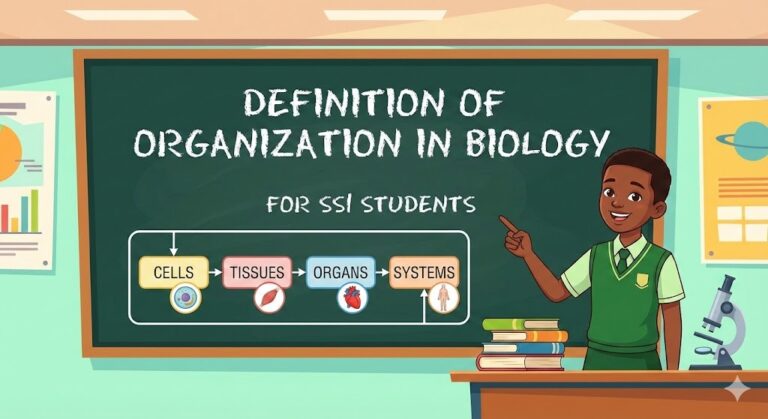
Think of a cell like a cement block. Just as many blocks come together to build a house, many cells come together to build a living organism (like a human being or a mango tree).
Structure of a Plant Cell
A plant cell is a eukaryotic cell that is enclosed by a rigid cell wall and contains special organelles for photosynthesis.
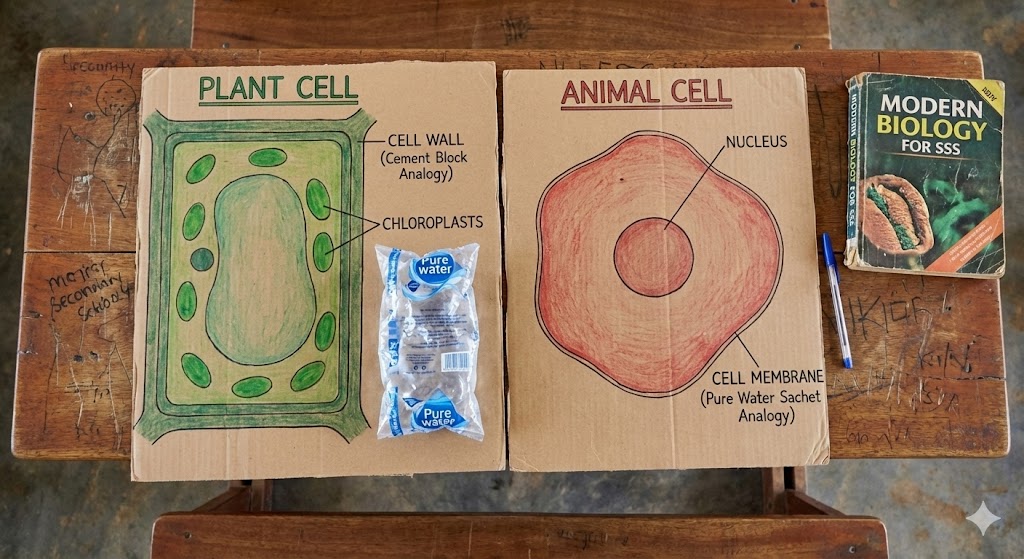
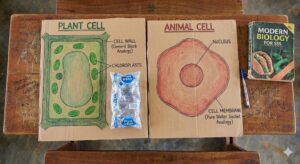
The most distinct feature here is the shape. Plant cells are usually rectangular or cubic. Why? Because they have a Cell Wall made of cellulose. This wall is like the concrete fence around a Nigerian house—it provides strong protection and gives the cell a fixed shape.
Inside the plant cell, you will also find Chloroplasts. These are the “kitchens” of the cell where food is cooked using sunlight (photosynthesis). Without these, plants would not be green.
You can read more about the Plant Cell structure here.
Structure of an Animal Cell
An animal cell is a eukaryotic cell that lacks a cell wall and has an irregular, flexible shape.
Unlike the plant cell, the animal cell is like a pure water sachet (nylon). It is flexible and can change shape slightly because it is only held together by a thin Cell Membrane. It does not have a hard outer shell.
Animal cells are consumers. Since they don’t cook their own food, they do not have chloroplasts. However, they have other specialized organelles like Centrioles which help them divide during reproduction.
Differences Between Plant and Animal Cells
This is the most important part of this note. In your exams, you must present this information in a table. Do not write a long story; examiners hate that.
| Feature | Plant Cell | Animal Cell |
| Cell Wall | Present (Made of cellulose) | Absent |
| Shape | Fixed, rectangular shape | Irregular, flexible shape |
| Chloroplasts | Present (For photosynthesis) | Absent |
| Vacuole | Large, central permanent vacuole | Small, temporary, or absent |
| Centrioles | Absent (except in lower plants) | Present (For cell division) |
| Food Storage | Stored as Starch grains | Stored as Glycogen |
| Nucleus Position | Pushed to the side by the vacuole | Usually in the center |
Let me break down the “Food Storage” difference:
Plants store their excess food as Starch (that is why yam and cassava are starchy). Animals store their excess food as Glycogen (fat). If animals stored starch, we would all be stiff like tubers of yam!
Similarities Between Plant and Animal Cells
Don’t let the differences fool you; they are essentially cousins. Both of them are Eukaryotic cells, meaning they have a defined nucleus.
Here is what they share:
-
Nucleus: Both have a nucleus that controls cell activities.
-
Cytoplasm: Both have a jelly-like substance where organelles float.
-
Cell Membrane: Both have a thin layer that controls what enters and leaves.
-
Mitochondria: Both need energy, so they both have the “powerhouse” of the cell.
Conclusion
Understanding the differences between plant and animal cells is not just about memorizing a table. It is about knowing how life works. Plants need to be rigid to stand tall against the wind, so they have cell walls. Animals need to move, so they have flexible membranes.
Make sure you practice drawing these two diagrams. If you can draw and label them correctly without looking at your textbook, you are ready for your exam. Good luck!