What are the Differences Between Plant and Animals
Differences Between Plant and Animals
Let’s be honest, this is the most popular question in exams. Every single year, they ask students to distinguish differences between plant and animals, yet many students still lose easy marks. Why? Because they write “Plants are green” and “Animals are not green.” That is a primary school answer.
In secondary school Biology, we look at specific characteristics like nutrition, movement, and cell structure. If you want to score an A1, you need to use the correct technical terms. Grab your notebook, let’s break it down.
Definition of Plants and Animals
Plants are multicellular living organisms that belong to the kingdom Plantae and are capable of manufacturing their own food through photosynthesis. They are the producers in the ecosystem.
Animals are multicellular living organisms belonging to the kingdom Animalia that depend on other organisms for food. They are consumers.
Think of it this way: Plants are the chefs who cook the food from scratch, while animals are the customers who just show up to eat.
Mode of Feeding (Nutrition)
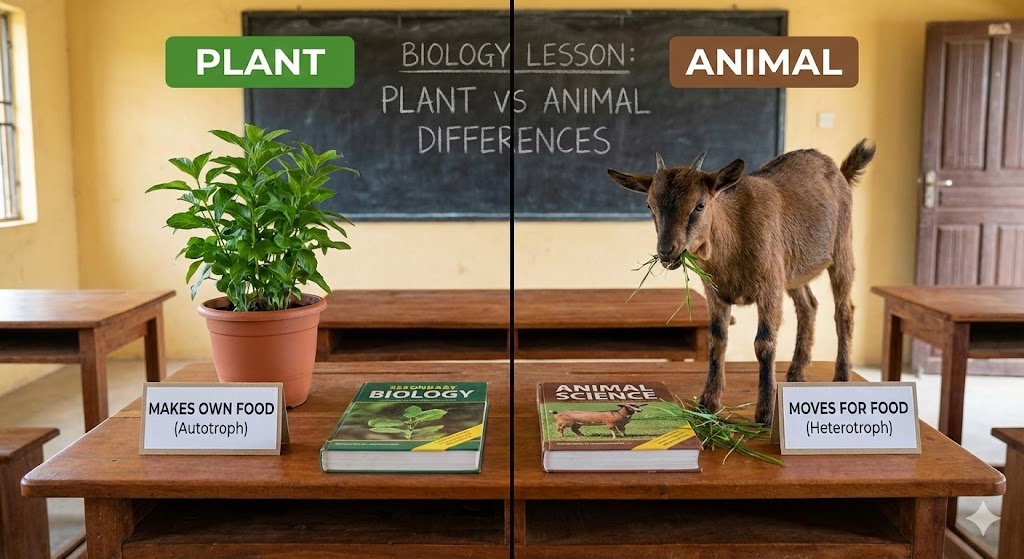
Plants practice autotrophic nutrition, meaning they manufacture their own food using sunlight, carbon dioxide, and water. They have a green pigment called chlorophyll which traps sunlight for this process.
Animals practice heterotrophic nutrition, meaning they depend on plants or other animals for ready-made food. Animals cannot make their own food inside their bodies.
Analogy:
Imagine a house where the mother cooks food in the kitchen (that is the Plant). Now imagine a boy who goes to a “Mama Put” to buy rice (that is the Animal). The plant produces; the animal consumes.
You can read more about Autotrophic Nutrition here.
Mode of Movement
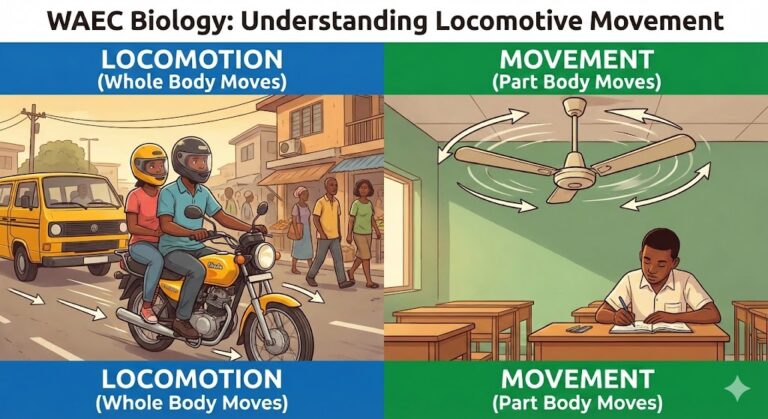
Plants are generally stationary organisms that do not move from one place to another. They only show restricted movements, such as the bending of a stem towards light or roots growing towards water.
Animals possess the ability of locomotion, which means they can move their whole body from one place to another in search of food, shelter, or mates.
Analogy:
A plant is like a Landlord—it stays in one compound forever. An animal is like a commercial bus driver—it moves from Oshodi to CMS looking for passengers (food).
Growth Patterns
Growth in plants is apical and indefinite, meaning it occurs only at the tips of roots and shoots and continues throughout the plant’s life. A mango tree, for instance, can keep bringing out new branches for 50 years.
Growth in animals is intercalary and definite, meaning it occurs in all parts of the body but stops when the animal reaches maturity. You will never see a 40-year-old man suddenly growing taller.
Response to Stimuli (Irritability)
Plants respond slowly to external stimuli. Their response is usually a slow growth movement, like a sunflower turning to face the sun over several hours.
Animals respond very quickly to external stimuli because they have a developed nervous system and sense organs. If you touch a hot stove, you pull your hand away instantly. That is animal irritability.
Cell Structure Differences
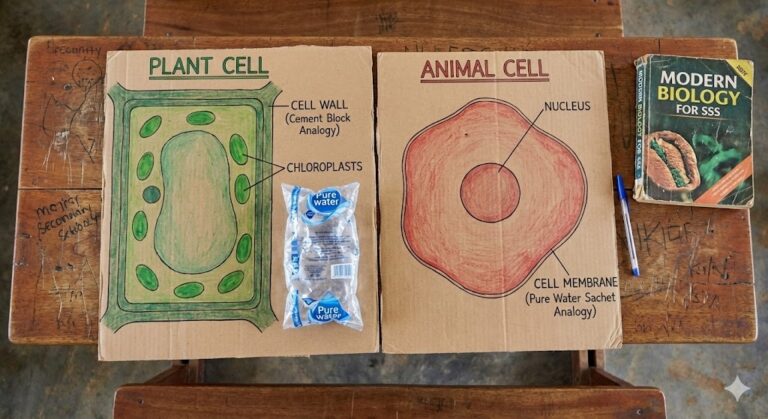
Plant cells have a rigid cell wall made of cellulose and contain organelles called chloroplasts. The cell wall gives them a fixed, rectangular shape.
Animal cells do not have a cell wall or chloroplasts. They only have a cell membrane, which makes their shape irregular and flexible.
This is why vegetables are crunchy (cell wall), but meat is soft and chewy.
Table of Differences Between Plants and Animals
In your exam, you must draw a table. Do not write this in a paragraph if the question asks for differences.
| Characteristic | Plants | Animals |
| Nutrition | Autotrophic (Make their own food) | Heterotrophic (Depend on others) |
| Movement | Stationary (Fixed in one spot) | Locomotion (Move whole body) |
| Growth | Indefinite (Continues throughout life) | Definite (Stops at maturity) |
| Cell Wall | Present (Made of cellulose) | Absent |
| Chlorophyll | Present (For photosynthesis) | Absent |
| Excretion | Have no specialized excretory organs | Have specialized organs (kidney, skin) |
| Storage | Store food as Starch | Store food as Glycogen |
Similarities Between Plants and Animals (Extra Marks)
Most students forget this part. Sometimes, WAEC will ask for similarities to trick you. Here is the truth: despite their differences, they are both living things.
-
Both carry out respiration to release energy.
-
Both reproduce to continue their species.
-
Both grow and develop.
-
Both are made up of cells.
Conclusion
Mastering the differences between plant and animals is the first step in understanding Biology. Don’t just memorize the table; understand the “why.” Why do plants need cell walls? Because they don’t have skeletons to hold them up!
If you can explain it like that, you are ready for your exams. Good luck.