Locomotion Movement Explained: WAEC Biology Study Guide (2025)
Locomotion Movement Explained: WAEC Biology Study Guide (2025)
Let’s be honest, Biology is sweet until you reach the topic of bones and muscles. That is where many students start scratching their heads. But you don’t need to stress. This topic often comes up in Section A of WAEC and NECO, and it is actually straightforward if you follow the rules.
Locomotive movement is simply how living things get from Point A to Point B. Think of it like this: if you are sitting in your classroom, you are not showing locomotion. But the moment you stand up and walk to the canteen to buy meat pie, that is locomotion.
Let us break this down so you can copy it into your notebook.
Definition of Locomotion
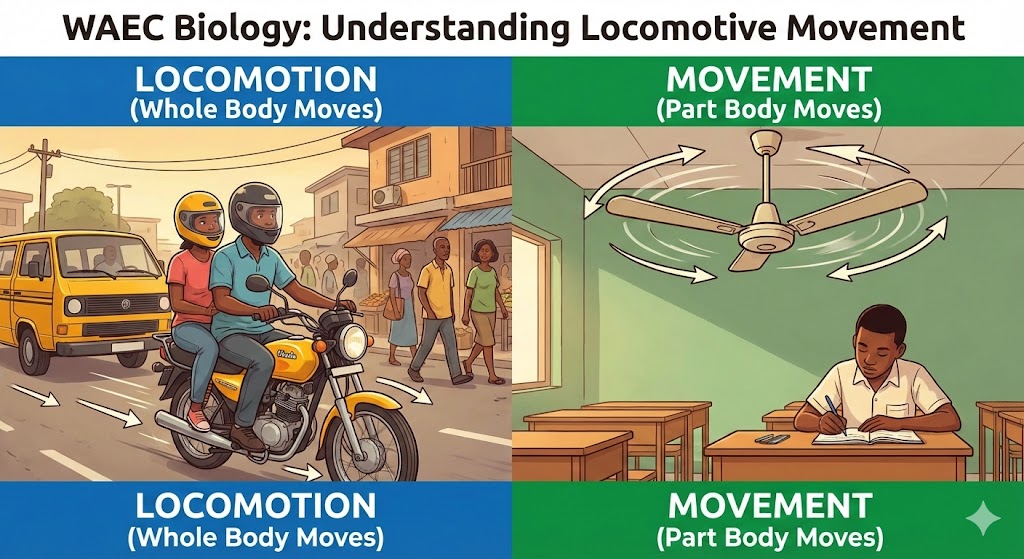
Locomotion is the ability of an organism to move its whole body from one specific place to another. This is different from simple movement. In movement, only part of the body (like your arm) moves, but in locomotion, the entire organism changes its position.
Plants move (they grow towards light), but they do not locomote. Animals locomote.
Think of it like this: A ceiling fan spins, but it stays on the ceiling. That is movement. An Okada rider drives from Ikeja to Berger. That is locomotion.
Importance of Locomotion to Organisms
The primary reason organisms move is to ensure their survival in a harsh environment. If an animal stays in one spot, it will likely die of hunger or get eaten.
Here are the main reasons why animals move:
-
To search for food: Plants can make their own food, but animals must move to find it.
-
To escape from predators: If a lion is chasing a goat, the goat will not wait to be eaten. It must move.
-
To find mates: Reproduction requires organisms to meet.
-
To avoid unfavorable conditions: Just as you run inside when rain starts falling, animals move away from extreme heat or cold.
-
To reduce overcrowding: When too many organisms are in one place, they move out to find new territory.
Organelles for Movement in Unicellular Organisms
These are microscopic structures used by single-celled organisms to move through water. Since these organisms are tiny, they don’t have legs or bones. They use special parts called organelles.
1. Pseudopodia (False Feet)
-
Organism: Amoeba.
-
How it works: The Amoeba pushes its cytoplasm out in one direction, and the rest of the body flows into it.
-
Analogy: Imagine pouring water on a table; it flows in a specific direction. That is how an Amoeba moves.
2. Cilia
-
Organism: Paramecium.
-
How it works: These are tiny, hair-like structures covering the whole body. They beat rhythmically like oars on a canoe to push the organism forward. You can read more about Cilia here.
3. Flagella
-
Organism: Euglena or Trypanosome.
-
How it works: This is a long, whip-like tail. The organism lashes it back and forth to propel itself.
Locomotion in Multicellular Organisms
Multicellular animals use muscles and skeletons to achieve movement. The complexity of the movement depends on the animal.
1. In Earthworms Earthworms do not have legs. They use tiny bristles called Setae (or Chaetae) and two sets of muscles: circular and longitudinal muscles.
-
When the circular muscles contract, the worm becomes long and thin.
-
When the longitudinal muscles contract, the worm becomes short and fat.
-
This alternating movement helps it crawl.
2. In Arthropods (Insects) Insects like cockroaches have a hard outer covering called an Exoskeleton. Their muscles are attached to the inside of this shell. They use legs for walking and wings for flying.
3. In Vertebrates (Mammals) We use an Endoskeleton (bones inside the body). Our movement relies on the partnership between bones, muscles, and nerves.
Types of Joints in Mammals
A joint is a point where two or more bones meet in the body. Without joints, you would be stiff like a statue. The most common type of joint allows for free movement and is called a Synovial Joint.
Here are the main types you must know for your exam:
1. Ball and Socket Joint
-
Description: A round head of one bone fits into a cup-shaped cavity of another bone. It allows movement in all directions (360 degrees).
-
Location: Shoulder and Hip.
-
Analogy: Think of a mortar and pestle. You can grind the pepper in a circle.
2. Hinge Joint
-
-
Description: This allows movement in only one plane (backward and forward). It cannot rotate.
-
Location: Elbow and Knee.
-
Analogy: A door. A door can open and close, but you cannot spin a door around unless you break the hinges.
-
3. Pivot Joint
-
Description: Allows rotation of one bone around another.
-
Location: The neck (atlas and axis vertebrae). This is why you can shake your head “No.”
4. Gliding/Sliding Joint
-
Description: Bones slide over one another.
-
Location: Wrist and Ankle.
Mechanism of Muscular Contraction
This is the process where muscles shorten and pull on bones to cause movement. The most important thing to remember here is the concept of Antagonistic Muscles.
Muscles work in pairs. They can only pull; they cannot push. Because of this, when one muscle contracts (shortens), the opposing muscle must relax (lengthen).
Example: Bending the Arm
-
To bend your arm, the Biceps (front muscle) contracts.
-
At the same time, the Triceps (back muscle) relaxes.
-
To straighten the arm, the reverse happens: Triceps contract, and Biceps relax.
I always tell my students: Imagine a tug-of-war. For one side to win (move), they must pull hard while the other side gives way.
Extra Marks: Movement vs. Locomotion
WAEC examiners love to ask the difference between these two. If you want that A1, memorize this table.
Conclusion
Don’t overcomplicate this topic. Focus on the examples. Remember that Amoeba uses pseudopodia, and your elbow is a hinge joint. If you can remember the difference between an Okada (locomotion) and a Ceiling Fan (movement), you are already halfway to passing this section.
Good luck with your study!