What is Agriculture? Definition and Importance Explained Simply
What is Agriculture? Definition and Importance Explained Simply
Does this topic give you a headache when you open your textbook? You are not alone. I see students struggle with this every year, yet the importance of agriculture is one of the most frequent questions in WAEC and NECO exams.
Let’s be honest. You cannot escape this topic if you want that A1. But don’t worry, I am going to break it down for you so it sticks in your brain like gum on a shoe. No big grammar, just the facts you need to write and pass.
Meaning of Agriculture
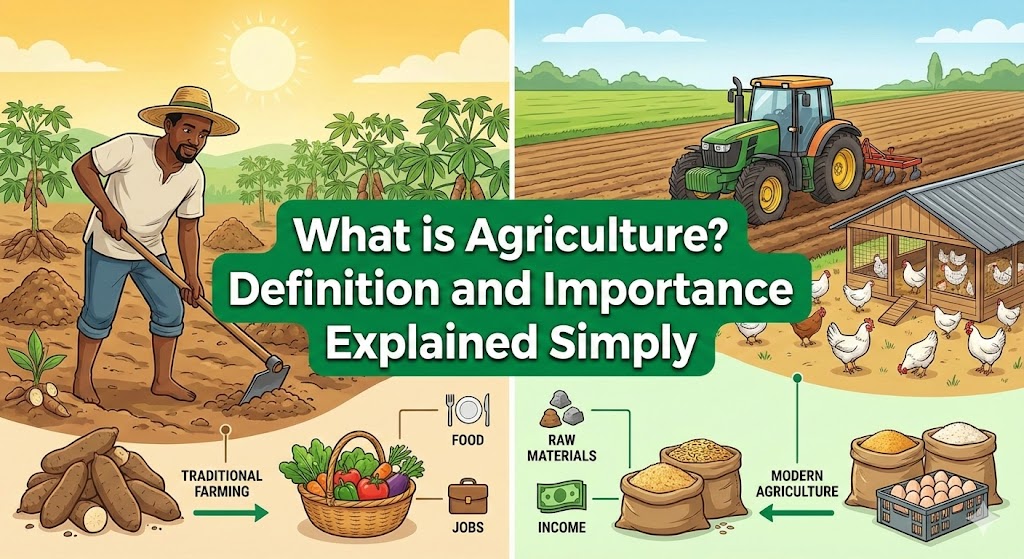
Agriculture is the art and science of cultivating the soil, growing crops, and rearing animals for man’s use. It comes from two Latin words: “Ager” meaning field, and “Cultura” meaning cultivation.
Many students think agriculture is just about an old man with a hoe and cutlass in the village. That is wrong. It goes way beyond that. It includes processing, marketing, and even the research scientists do in the lab. Think of it as the complete journey of food from the farm to your plate. If you are eating rice today, agriculture made it happen.
Importance of Agriculture in Nigeria
Why does the government always shout about “going back to the farm”? Here is the truth. Agriculture is the backbone of our survival. Without it, everything else pauses.
-
Provision of Food: This is the most obvious one. Agriculture provides food for the teeming population. Without farmers, the popular “0-0-1” or “1-0-1” feeding formula many students use would not even exist; it would be “0-0-0”. It prevents starvation.
-
Source of Raw Materials for Industries: Industries cannot function without farm produce. Think of a tailor. Can he sew a buba without fabric? No. In the same way, the textile industry relies on cotton from farmers. The beverage companies need cocoa and coffee. Agriculture feeds the factories.
-
Source of Foreign Exchange: When we sell cash crops like cocoa, rubber, and palm oil to other countries, Nigeria gets foreign currency (Dollars and Pounds). It is just like an Igbo merchant at Alaba International Market selling goods to bring money into the shop. This helps our economy grow. You can read more about global trade in agriculture on Wikipedia.
-
Employment Opportunities: Agriculture is the biggest employer of labour in Nigeria. Look at your extended family. There is a high chance you have an uncle or grandfather in the village who farms. From the driver transporting yams to Lagos, to the market woman selling tomatoes, agriculture gives millions of people jobs.
-
Source of Income: Farmers sell their produce to make money to take care of their families. That yam farmer in Benue sells his harvest in December to pay school fees in January. It is a business.
Branches of Agriculture
Agriculture is very wide. It is like a big house with many rooms. Here are the main branches you must know for your objective questions:
-
Animal Science: This deals with the breeding and management of farm animals (livestock) like cattle, poultry, and goats.
-
Crop Production: This focuses on growing plants for food and other uses. It covers everything from maize to cassava.
-
Soil Science: This is the study of the soil itself—how to keep it fertile so crops can grow well.
-
Agricultural Economics: This branch deals with the business side. It looks at profit, loss, and marketing of farm produce.
-
Forestry: This involves the management of forest resources like timber for furniture and paper.
-
Fishery: The business of breeding and catching fish.
Problems Facing Agriculture in Nigeria
I always tell my students this part is crucial for “Section B” theory questions. If agriculture is so good, why are we still hungry?
-
Inadequate Land Tenure System: The way land is shared in Nigeria is a problem. You might want to farm, but the land belongs to a distant community that won’t sell. It limits large-scale farming.
-
Poor Transportation Network: Have you seen the roads leading to some villages? They are terrible. A farmer might harvest fresh tomatoes, but before he gets them to the market in the city, the truck breaks down, and the tomatoes spoil.
-
Lack of Capital (Money): Farming is expensive. Most rural farmers are poor and cannot get loans from banks because they have no collateral. Without money, they cannot buy tractors or fertilizer.
-
Use of Crude Tools: Many farmers still use hoes and cutlasses. You cannot feed over 200 million people using tools from the 1960s. We need mechanization.
Modern Trends in Agriculture
Note: This is the “extra marks” section. Most students won’t write this, but if you do, the marker will know you are a serious student.
Today, agriculture has moved to Hydroponics. This is growing crops without soil, using just nutrient-rich water. It is becoming popular in cities like Lagos where land is scarce. Also, Snail Farming (Heliculture) is a goldmine now because it requires small space but brings big profit. The Food and Agriculture Organization (FAO) often discusses these sustainable methods to fight hunger.
Conclusion
Do not let the size of this topic scare you. In the exam, focus on the definitions and just remember the analogies: the tailor needing fabric (raw materials) and the village uncle needing a job (employment). If you can explain it like that, you will score high.
No shaking, you’ve got this. Good luck with your study!