Definition of Organization in Biology Explained for SS1 Students
Definition of Organization in Biology Explained for SS1 Students
Does this topic confuse you every time you open your Modern Biology textbook? You are not alone. Many students struggle to understand why we move from cells to systems, but it is actually one of the easiest topics in SS1 if you calm down.
Here is the truth.
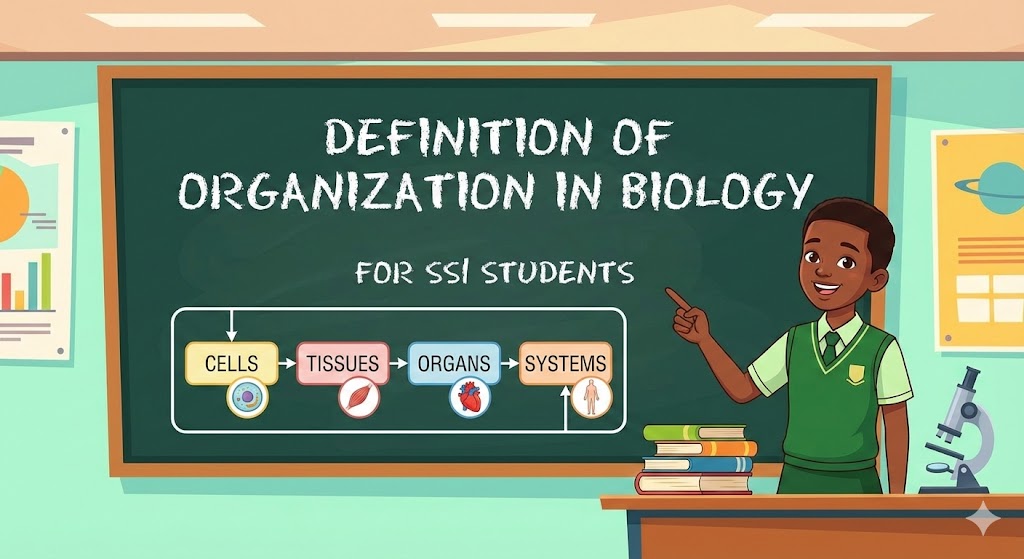
The definition of organization in biology is simply how life is arranged from the smallest unit to the biggest, most complex structure. If you master this hierarchy today, you will breeze through the first two questions in your WAEC objective section. Let’s break it down properly.
Meaning of Organization of Life
Organization of life refers to the arrangement of smaller, simpler components to form larger, more complex and efficient organisms. It is the hierarchy of life.
Think of it like building a house in Lagos. You cannot just have a house appear from nowhere. You start with a single block. Then you join blocks to make a wall. You join walls to make a room. Finally, you join rooms to make a full duplex. In biology, we don’t use blocks; we use cells. But the logic? It is exactly the same. Without this arrangement, life would be chaotic and complex organisms like humans or mango trees would not exist.
Levels of Biological Organization
The levels of organization are the four distinct stages of complexity found in living things.
I always tell my students to memorize this order because examiners love to ask you to arrange them. If you mix it up, you lose the mark.
-
Cell Level: The beginner level.
-
Tissue Level: The team level.
-
Organ Level: The manager level.
-
System Level: The boss level.
The Cell Level of Organization
The cell is the smallest, basic structural and functional unit of life that can exist on its own or as part of a larger organism. This is the foundation of everything.
Some organisms stop here. They are called unicellular organisms. They are like a “one-man business.” One person does the marketing, the selling, and the cleaning. In the same way, a single cell like the Amoeba does everything—feeding, movement, and excretion—all by itself. It is simple, but it works.
Examples of Cell Level Organization:
-
Amoeba
-
Paramecium
-
Euglena
-
Chlamydomonas
You can read more about the structure of these single cells on Britannica’s Guide to Unicellular Organisms.
The Tissue Level of Organization
A tissue is a group of similar cells that come together to perform a specific function.
Imagine you have plenty of blocks. If you pile them together, you get a wall. That wall is a tissue. In the body, cells don’t just float around aimlessly; they team up. When a group of cells decides to focus only on movement, they become muscle tissue.
However, you need to be careful here. Some organisms exist only at this level. They have moved past being single cells, but they are not yet complex enough to have real organs.
Examples of Tissue Level Organization:
-
Hydra (This is the classic WAEC example).
-
Sponge.
-
In plants: Epidermal tissue (the skin of the leaf).
-
In animals: Muscle tissue, Blood (yes, blood is a liquid tissue).
The Organ Level of Organization
An organ is a group of different tissues working together to perform a specific, major function.
This is where things get serious. Think of an organ like a specific room in a house, say the kitchen. The kitchen has walls (tissues), tiles (tissues), and plumbing (tissues), but they all work together for one purpose: cooking. In your body, the heart is an organ. It contains muscle tissue to pump, nerve tissue to control the beat, and connective tissue to hold it together.
Examples of Organ Level Organization:
-
In Animals: Heart, Kidney, Skin, Eye.
-
In Plants: Leaf, Root, Stem, Onion bulb (Note: An onion bulb is an underground storage organ).
For a deeper look at how plant organs function, check out this resource from Biology LibreTexts.
The System Level of Organization
A system is a collection of different organs working together to carry out a major life process.
This is the highest level of organization in a single organism. It is like the Federal Government. The Ministry of Education, Ministry of Finance, and Ministry of Works are all “organs,” but together they form the “System” that runs the country. If one organ fails—like the kidney in the Excretory System—the whole system suffers.
Examples of System Level Organization:
-
Digestive System (Mouth, Stomach, Intestines).
-
Transport System (Heart, Blood vessels).
-
Nervous System (Brain, Spinal cord).
Complexity of Organization in Higher Organisms
Complexity of organization refers to the advantages an organism enjoys because it is made of many specialized parts.
Why go through all this stress of combining cells? Why not just stay as an Amoeba? Well, survival. A single-celled organism is limited. If the environment gets too hot or dry, it might die instantly. But a complex organism like a human or a goat has systems to regulate temperature and store water.
Advantages of Complexity:
-
Specialization: Different parts do different jobs efficiently. The eyes see, the legs walk. You don’t have to try to see with your legs.
-
Size: It allows organisms to grow large.
-
Survival: It increases the ability to survive in harsh environments.
Modern Advantages of Biological Organization
This is the part most textbooks skip, but you need it for Section B questions on “Adaptation.”
The biggest advantage of high-level organization is Division of Labour. Just like in a bank where the security guard is not the same person counting the money, complex organisms divide the work. This ensures that no single cell is overworked. If you are writing an essay on this, always mention that division of labour leads to efficiency. The cells last longer, and the organism functions better.
Conclusion
Biology is not hard; it is just a story of how life builds itself. From the tiny cell to the complex system, everything has a place.
Go over the examples for Tissue and Organ level again—those are the ones that usually confuse students in the exam hall. No shaking, you are ready to smash this topic. Good luck!



One Comment