Family Life Education: Meaning, Types, and Roles (Exam Success Guide)
Family Life Education: Meaning, Types, and Roles (Exam Success Guide)
Do you get a headache when you see questions about the family in Section A of your exam? You shouldn’t. This topic is actually one of the easiest parts of Social Studies and Civic Education if you just calm down and understand the basics. In this guide, we are breaking down family life education so you can crush those WAEC, NECO, or JSS exam questions without sweating.
I always tell my students: don’t just memorize the “big grammar” in the textbook. Understand it like you understand the rules of a football match. Let’s get into it.

Meaning of Family Life Education
Family Life Education is a learning process that helps individuals acquire knowledge, skills, and values for successful family living. It is not just about reproduction or biology. It is about understanding how to relate with people, how to manage resources, and how to make good decisions as you grow up.
Think of it this way. If you buy a complex machine, it comes with a manual. If you don’t read the manual, you will spoil the machine. Family Life Education is that manual for your life. It prepares you for the responsibilities of adulthood so you don’t crash before you even leave the garage.
Meaning of Family
A family is a specific group of people related by blood, marriage, or adoption who live together and share common resources. It is the primary social unit in any society. According to Wikipedia, it is the fundamental group in society.
This is the standard definition you must write in your exam. But here is the breakdown. Imagine the family is the foundation of a house. If you use cheap cement (bad values) for the foundation, the whole building (the society) will eventually collapse. If the family is strong, the country is strong. It is that simple.
Types of Family
The types of family are generally classified into two main categories based on structure. In Nigeria, we see both of these every day.
-
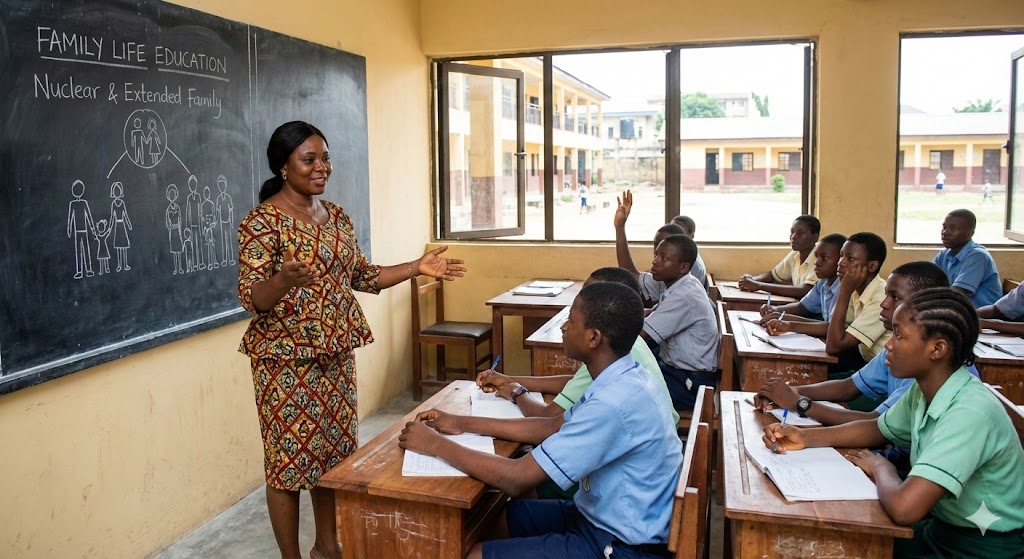
Nuclear Family: This consists of only the father, mother, and their biological or adopted children. It is small and compact. Think of the Nuclear family like a “Self-contain” apartment in Lagos. It is private, strictly for the immediate members, and decisions are made quickly because there are fewer people involved.
-
Extended Family: This includes the nuclear family plus other relatives like uncles, aunts, grandparents, cousins, and nephews. This is the traditional African system. It is like a “Face-me-I-face-you” building. It is crowded, loud, and everyone is involved in everyone’s business. However, the support system is massive. If you fall, someone is there to catch you.
Roles of Family Members
Roles of family members refer to the specific duties and responsibilities assigned to each person in the home. You cannot play a football match where the goalkeeper is trying to play striker. Everyone has a position. If you leave your position, the team loses.
-
Father: He is the head of the home. His primary job is provision. He provides money for food, school fees, and shelter. He is also the protector of the family unit.
-
Mother: She manages the household affairs. While modern mothers also work and provide money, their traditional role involves the emotional and physical care of the children and the home. She supports the father in decision-making.
-
Children: Your job is simple but hard. Obey your parents. Run errands. Perform household chores like sweeping, washing plates, or fetching water. And most importantly, take your studies seriously so you don’t waste the school fees provided by the father.
Functions of the Family
Functions of the family are the biological and social duties the family performs to keep society running. Without these functions, humans would go extinct.
-
Procreation: The family guarantees the continuity of the human race through childbirth. It is the only socially approved institution for having children.
-
Socialization: This is where you learn how to talk, greet, and behave. The family is your first school. As noted by UNICEF, early childhood development happens primarily at home. If a child is rude outside, people don’t blame the school; they blame the parents.
-
Protection: The family provides physical security and emotional support. When the world beats you up, you run home.
-
Economic Support: The family provides food, clothes, and shelter until the children are old enough to fend for themselves.
Importance of Good Family Reputation
Importance of good family reputation refers to the value of a “Good Name” in the community. In Nigeria, our elders say a good name is better than riches.
Imagine your family name is a crisp, white school uniform. If one person in the family behaves badly—maybe they are caught stealing or fighting—it puts a permanent red palm oil stain on that uniform. Everyone sees it on the assembly ground. A good reputation opens doors for you before you even knock. A bad reputation slams them shut.
Challenges Facing the Modern Family
Challenges facing the modern family are the new problems that did not really exist in our grandfathers’ time. The world has changed, and families are struggling to keep up.
-
Technology Addiction: Everyone is on their phone. Nobody talks at the dinner table anymore. Parents are on WhatsApp, children are on TikTok, and the family bond is weakening.
-
Economic Pressure: The cost of living is high. Both parents often have to work late hours just to put food on the table, leaving children in the care of house helps or cartoons.
-
Single Parenting: Due to high rates of divorce or separation, many children are growing up with only one parent. This can sometimes create emotional gaps or financial strain if not managed well.
Conclusion
Look, don’t overcomplicate this topic. Read your notes, remember the analogies about the “Self-contain” apartment versus the “Face-me-I-face-you” house, and you will pass. The examiners just want to see that you understand how the family works in real life. Go and smash that exam. No shaking.

One Comment