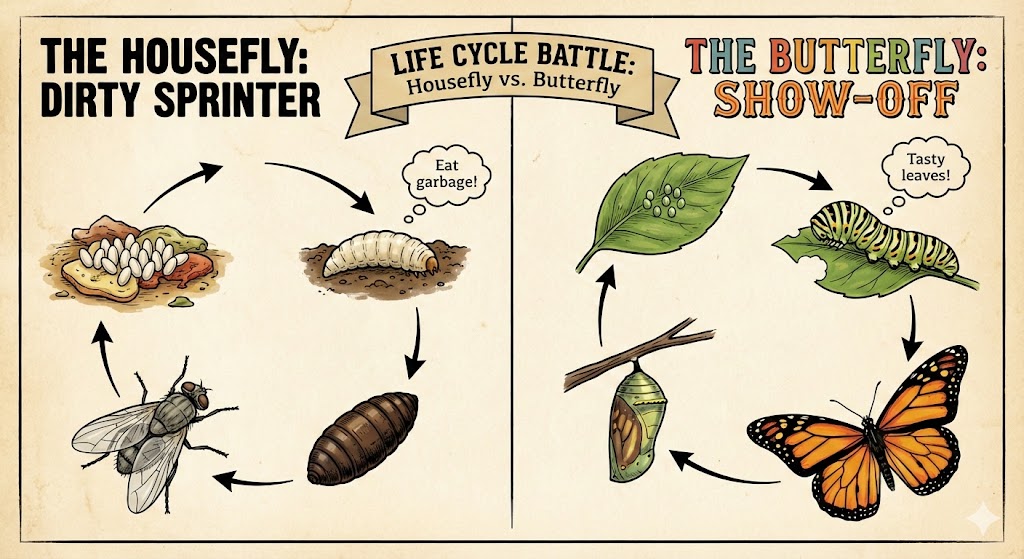
Life cycle of a Housefly vs. Butterfly
Life cycle of a Housefly vs. Butterfly
Welcome to class! Sit down, stop dragging that chair like a generator.
Let me tell you something—I actually hate houseflies with a passion that worries my wife sometimes. Last week, I was trying to enjoy my Amala at that Mama Basira’s spot down the road—you know the one with the angry cashier—and this stubborn fly kept trying to land on my meat. I swatted it, it came back. I swatted it again, it did a tactical retreat and came back with backup. It’s annoying. But you see, that annoyance is what we’re studying today. We are looking at how that tiny nuisance grows from a dot to a devil, and comparing it to the butterfly, which everyone somehow likes just because it has colorful wings. Bias, basically.
Here is the textbook definition you need to cram.
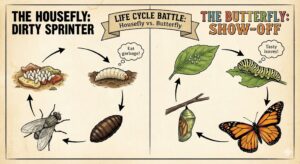
Complete Metamorphosis: A type of insect development involving four distinct stages: Egg, Larva, Pupa, and Adult (Imago). Both the Housefly (Musca domestica) and Butterfly (Papilio demodocus) undergo this process.
The Housefly: The Dirty Sprinter
So, why is the housefly always in a rush?
Because its life is short and dangerous. See, the housefly life cycle is incredibly fast—it can finish everything in like 6 to 10 days if the weather is hot like Lagos traffic—which is why they multiply so quickly.
The Kitchen Analogy: Think of the Housefly Larva (the Maggot) as a vacuum cleaner in a messy kitchen. It has no legs, no eyes, it just drags itself through dirt and rotting food, sucking up everything in its path to get fat quickly. It doesn’t care about presentation. It just eats garbage.
Key features you must know:
-
Eggs: Laid in batches on decaying matter. Not one or two. Hundreds.
-
Larva (Maggot): White, segmentation is clear, head is reduced to a hook. It looks disgusting.
-
Pupa: It’s a barrel shape. Brown/Dark. It doesn’t move.
-
Adult: One pair of wings for flying, one pair of “halteres” for balancing (WAEC likes to ask about halteres, don’t forget that).
The Butterfly: The Show-Off
Why does the Butterfly take so long to get ready?
It’s a drama queen. The butterfly takes its time—sometimes months depending on the species—because it’s building something complex.
The Kitchen Analogy: The Caterpillar (Butterfly Larva) is like a greedy chef tasting the soup. It has a specific taste—it usually eats leaves from citrus plants or specific vegetables—and it uses strong jaws (mandibles) to chew, unlike the maggot that just absorbs liquid trash.
Key features you must know:
-
Larva (Caterpillar): It has legs! True legs at the front, and “prolegs” (fake legs) at the back. It eats solid food.
-
Pupa (Chrysalis): It hangs upside down, usually attached to a twig with silk. It looks like a dry leaf sometimes.
-
Adult: Two pairs of wings covered in scales. Siphoning mouthparts (a long straw) for drinking nectar.
The “Real Talk” Section
Look, you might think this is just biology, but this is actually about your health.
When you buy that puff-puff by the roadside and you see a fly rub its legs together, it’s not washing its hands—it’s actually cleaning vomit and germs off its feet so it can taste your food better—because flies taste with their feet. Disgusting, right? Knowing the life cycle tells you that if you leave your dustbin open for just two days, you have already started a nursery school for maggots.
Butterflies are nicer, but their caterpillars can destroy a farmer’s crops in one week. If you plan to do Agric science, you better respect the caterpillar.
Exam Corner
WAEC will try to trick you here. They know you confuse the mouthparts. Don’t fall for it.
Likely Questions:
-
State three differences between the larva of a housefly and a butterfly.
-
Name the type of metamorphosis undergone by both insects.
-
What is the function of the halteres in a housefly?
-
Describe the mouthparts of the adult butterfly.
-
In which stage is the housefly most dangerous to human health? (Hint: It’s the adult).
Model Answers (Cheat Sheet Style):
Q1: Differences between Housefly Larva (Maggot) and Butterfly Larva (Caterpillar)
-
Don’t just write “One is big one is small.” Write this:
-
Legs: Maggot is legless; Caterpillar has true legs and prolegs.
-
Head: Maggot has a reduced, peg-like head; Caterpillar has a distinct head with ocelli (simple eyes).
-
Feeding: Maggot absorbs liquid food; Caterpillar chews solid leaves (mandibulate).
-
Q3: Function of Halteres
-
Answer: They are used for balancing during flight. (If you write “flying,” I will mark you wrong myself).
Outro:
Next class we do Aquatic Habitats. Bring your textbook, and stop sleeping in my class. See you.