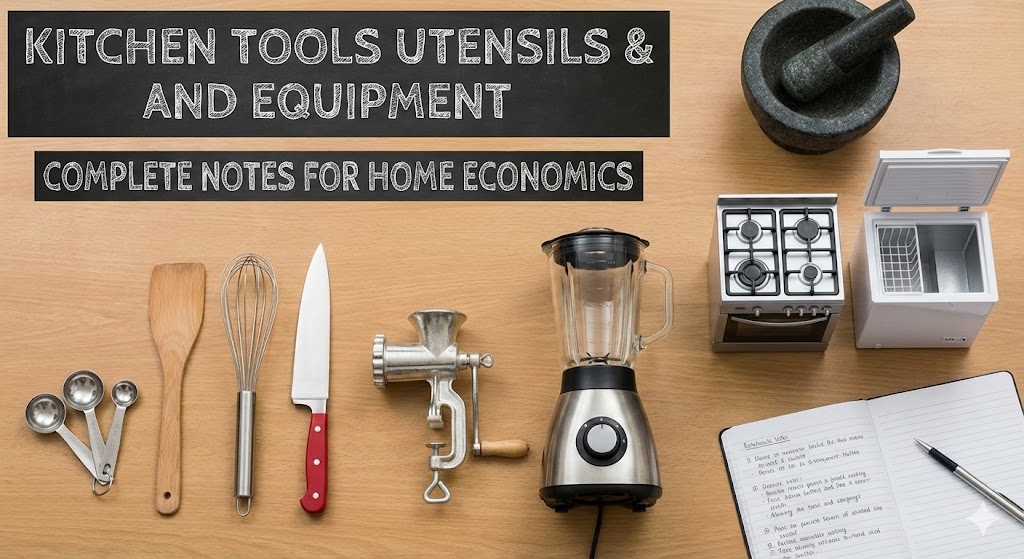
Kitchen Tools Utensils and Equipment: Complete Notes for Home Economics
Kitchen Tools Utensils and Equipment: Complete Notes for Home Economics
I know exactly why you are here. This topic is a favorite in Junior WAEC and even pops up in the practicals for SS3 students, yet people still mix up a simple spoon with “equipment.” It’s frustrating. Let’s fix that today so you can get your full marks.
Kitchen tools utensils and equipment are the necessary items we use for food preparation, cooking, serving, and storage. Without them, cooking is not just hard; it is basically impossible. Imagine trying to pound yam with your bare hands—it won’t work.
Definition of Kitchen Tools and Equipment
Kitchen tools and equipment refer to all the implements, appliances, and items used in the kitchen to make cooking easier, faster, and more hygienic.
Think of it this way: In a workshop, a carpenter needs a hammer and saw. In the kitchen, the cook needs knives and pots. We generally divide these items into two main groups based on their size and how they are moved.
-
Tools/Utensils: These are small, movable items you hold in your hand (like knives, spoons, and whisks).
-
Equipment: These are larger, often heavier items that are usually fixed in one spot or difficult to move around (like your refrigerator or gas cooker).
Classification of Kitchen Equipment
Kitchen equipment is classified into three major groups based on size and mode of operation.
These categories help us organize the kitchen so it doesn’t look like a marketplace where everything is scattered.
-
Small Equipment (Tools and Utensils): Handheld items.
-
Large Equipment: Heavy appliances.
-
Mechanical Equipment: Machines that use electricity or manual power to do hard work.
Small Kitchen Tools and Utensils
Small kitchen tools are handheld implements used for specific tasks like cutting, mixing, measuring, or serving.
These are the “apprentices” of the kitchen. They do the running around. You move them from the drawer to the table, to the sink, and back again. They are usually cheaper and made of stainless steel, wood, plastic, or aluminum.
Common Examples and Uses:
-
Knives: Used for cutting, chopping, and slicing. You have the Chef’s knife (for everything), the Paring knife (for peeling oranges or potatoes), and the Bread knife (serrated edge).
-
Teacher’s Tip: Never use a dull knife. A blunt knife is more dangerous than a sharp one because you have to use force, and if it slips, you are in trouble.
-
-
Colander: A bowl with holes used for draining water from boiled foods like rice or pasta. Don’t confuse this with a sieve; a sieve has a wire mesh for flour, while a colander has bigger holes.
-
Egg Whisk: Used for beating eggs or mixing light batters to introduce air.
-
Graters: Used for shredding foods like carrots, cheese, or unripe pawpaw for salad.
-
Chopping Board: A wooden or plastic board where you place food for cutting.
-
Hygiene Note: Avoid cutting raw meat and vegetables on the same board without washing it first. This causes cross-contamination. You can read more about safe food handling on FoodSafety.gov.
-
Large Kitchen Equipment
Large kitchen equipment refers to the heavy, permanent appliances used for cooking, cooling, or storage.
These are the “Ogas” of the kitchen. They command respect and occupy a permanent space. You don’t just wake up and decide to move your fridge to the parlor; it stays where it is. They are expensive and require careful handling.
Key Examples:
-
Cookers: These can be gas, electric, or kerosene stoves. They provide the heat needed for cooking.
-
Refrigerators and Freezers: Used for preserving perishable foods at low temperatures.
-
Kitchen Sink: Used for washing food and cleaning dirty utensils.
-
Cupboards and Shelves: Used for storing food items and other equipment.
Mechanical Kitchen Equipment
Mechanical kitchen equipment consists of machines that simplify difficult tasks like grinding, blending, or mixing.
These guys are the time-savers. In the old days, our grandmothers used grinding stones for pepper. It tasted good, but it took forever. Today, mechanical equipment does that job in seconds.
Examples:
-
Blender: Used for pureeing fruits, grinding tomatoes for stew, or making smoothies.
-
Mixer: Used for mixing cake batter or dough.
-
Toaster: Used specifically for browning bread.
-
Dishwasher: An automated machine for washing plates and cutlery (though this is less common in the average Nigerian home, it is still in the syllabus!).
Care and Maintenance of Kitchen Equipment
Care and maintenance involve the regular cleaning and servicing of kitchen items to make them last longer and prevent rust or damage.
If you don’t take care of your tools, you are wasting money. I always tell my students: a dirty kitchen is a playground for cockroaches.
Rules for Care:
-
Wash immediately: Do not leave dirty plates or pots overnight. It encourages bacteria and makes them harder to wash the next morning.
-
Dry before storing: Moisture causes rust, especially on tin or iron bakeware. Wipe them dry with a kitchen napkin.
-
Don’t soak wood: Never leave your wooden turning sticks or chopping boards soaking in water. The wood will swell, crack, and eventually rot.
-
Sharpen knives: Keep your knives sharp using a sharpening stone or steel.
-
Unplug appliances: When cleaning your blender or toaster, always remove the plug from the socket first. Water and electricity are enemies. For more on appliance safety, you can check general safety guidelines on Wikipedia.
Conclusion
Mastering kitchen tools utensils and equipment is not just about passing your Home Economics exam; it is a life skill. Whether you are running a restaurant or just cooking indomie at home, knowing the right tool for the job makes the difference. Go through these notes again, memorize the examples, and you will be ready for any question WAEC throws at you. Good luck!