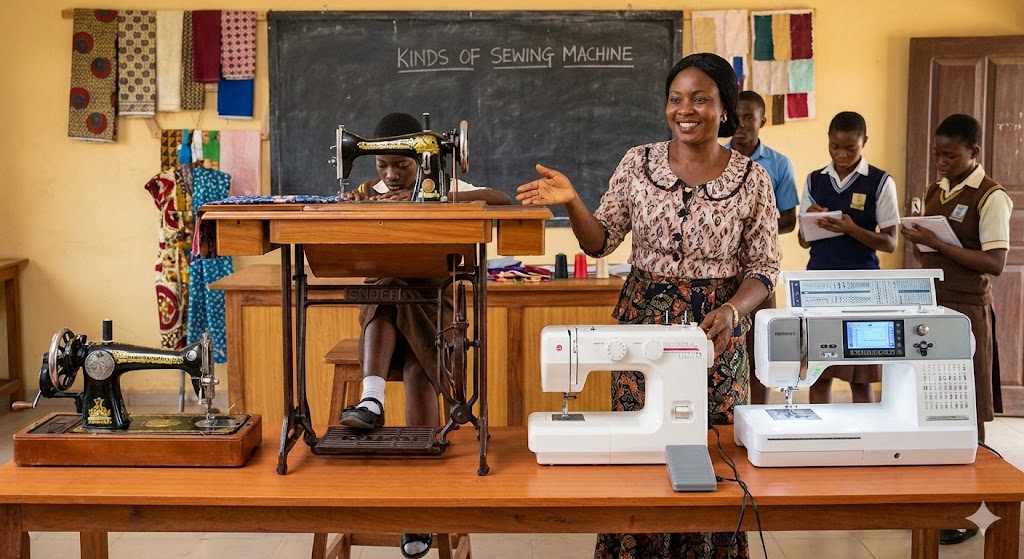
Kinds of Sewing Machine Explained for Home Economics Students
Kinds of Sewing Machine Explained for Home Economics Students
Let’s be honest, every Home Economics student gets nervous when they see questions about equipment in Section A of WAEC or NECO. You shouldn’t be. This topic is actually one of the easiest to master if you understand the basics.
Whether you want to be a fashion designer or you just need to pass your exams, understanding the different kinds of sewing machine is compulsory. In this note, I will break down exactly what you need to write in your notebook to get full marks. No long stories, just facts.
Meaning of a Sewing Machine
A sewing machine is a mechanical or electrical device used to join fabrics together with thread. It is the primary tool used by tailors, dressmakers, and fashion designers to construct garments efficiently.
Think of it as the engine of the fashion world. Before this invention, people had to sew everything by hand, which took days. Today, a machine does the work of ten people in an hour. It works by interlocking two threads—the upper thread (from the spool) and the lower thread (from the bobbin)—to form a stitch.
For a deeper history on how this invention changed the world, you can read more on Britannica’s history of sewing machines.
The Hand Sewing Machine
A hand sewing machine is a type of sewing machine that is operated manually by turning a handle attached to the balance wheel. This is the most common machine you will find in Nigerian homes and introductory Home Economics classes.
I always tell my students to start with this one. Why? It gives you total control. You determine the speed with your hand. It is like using a manual grinding machine in the kitchen—it requires muscle, but it gets the job done reliably.
Advantages:
-
It does not require electricity (very important given our power situation).
-
It is cheaper to buy and maintain.
-
It is portable and usually comes with a wooden box cover.
The Treadle Sewing Machine
A treadle sewing machine is operated by foot power using a treadle plate located at the base of the stand. The user places their feet on the plate and rocks them back and forth to generate movement.
If you go to any busy market like Tejuosho or Ariaria, this is what you see the professional tailors using. It is faster than the hand machine because your hands are free to guide the fabric. Think of it like riding a bicycle; once you get the rhythm of the pedaling, the machine moves smoothly.
Key Features:
-
It is mounted on a heavy stand (usually cast iron).
-
It uses a leather belt to connect the lower wheel to the machine head.
-
It can be very fast if the tailor has strong legs.
The Electric Sewing Machine
An electric sewing machine is powered by an electric motor attached to the balance wheel. You operate it by pressing a foot pedal that sends current to the motor.
This is the standard for modern fashion businesses. The motor does all the hard work. You just press your foot down—press harder for speed, lift off to stop. It makes sewing thick fabrics like denim or Ankara very easy. However, in Nigeria, you must have a standby generator or inverter to use this efficiently because once NEPA takes the light, work stops.
The Computerized Sewing Machine
A computerized sewing machine is an advanced machine controlled by microchips and software to perform complex stitches and embroidery. These are the “smartphones” of the sewing world.
Imagine comparing a “palasa” (button phone) to an iPhone 15. That is the difference between a manual machine and a computerized one. You can press a button, and the machine will sew a buttonhole, cut the thread, and even embroider a flower pattern automatically.
Characteristics:
-
It has an LCD screen to select stitches.
-
It is very expensive.
-
It is highly sensitive to voltage fluctuation (you need a stabilizer).
Functions of Sewing Machines
The primary function of any sewing machine is to join pieces of fabric together to make an article. However, depending on the type, they perform other specific duties.
Here is what you should list in an exam:
-
Mending: Repairing torn clothes or darning holes.
-
Decorative Stitches: Adding embroidery or fancy patterns to a garment.
-
Neatening: Preventing fabric edges from fraying (using zigzag stitches).
-
Attachment: Fixing zippers, buttons, and elastic bands to clothes.
Factors for Choosing a Sewing Machine
Choosing a machine depends on what you need it for and your budget. Do not just buy what is shiny; buy what works.
-
Cost: How much money do you have? Hand machines are the cheapest.
-
Skill Level: Beginners should stick to hand machines. Professionals need industrial or electric ones.
-
Spare Parts Availability: This is critical. In Nigeria, the “black head” machines are popular because you can find their parts in almost every market.
-
Purpose: Are you sewing heavy jeans or light silk? Industrial machines handle heavy work better.
Care and Maintenance of Sewing Machines
Care and maintenance involve the regular cleaning and oiling of the machine to keep it in good working condition. A well-maintained machine can last for 50 years—seriously, some of your grandmothers are still using their wedding present machines.
Rules to follow:
-
Dusting: Always wipe the machine with a soft cloth before and after use to remove lint.
-
Oiling: Apply sewing machine oil to the moving parts regularly. Think of oil like water for the machine; without it, the metal parts will grind against each other and lock up.
-
Covering: Always cover the machine when not in use to prevent dust from entering the delicate parts.
-
Needle Check: Change your needle immediately if it becomes blunt. A blunt needle damages your fabric.
Why Most Nigerian Tailors Prefer the “Black Head” Machine
Here is the truth I found from years of teaching. While computerized machines are fancy, the classic black head machine (often brands like Butterfly or Singer) is the king of the Nigerian market.
Why? It is rugged. You can abuse it, overuse it, and it will still sew. It is purely mechanical, meaning no computer board can burn when the voltage spikes. For a student starting out, this is the best investment you can make. It holds its value and teaches you the mechanics of sewing without the confusion of digital screens.
Conclusion
Passing your Home Economics exam is not about memorizing big words; it is about understanding how these tools help us in the home. Remember, the machine is only as good as the person using it.
Make sure you practice threading the bobbin and the needle in your practical classes. If you can define the machine, list the types, and explain how to care for them, you are ready for that A.

One Comment