Tiers of Government in Nigeria: Full Notes for JSS3 and SS1 Students
Tiers of Government in Nigeria: Full Notes for JSS3 and SS1 Students
Civic Education students, listen up. If you are preparing for your BECE or WAEC, you cannot escape this topic. It shows up every single year in the objective section, and often as a full theory question.
The concept of the tiers of government is the foundation of how Nigeria works. Many students fail this because they confuse the duties of the State Government with the Local Government. Today, we will fix that confusion once and for all so you can secure your A.
Meaning of Tiers of Government
Tiers of government refers to the different levels at which government power is shared and exercised in a country. In a federal system like Nigeria, power is not held by just one person or one group; it is divided so that governance can reach the common man on the street.
Think of it like your secondary school. You have the Principal (Federal), the Class Teachers (State), and the Class Captain (Local). They all have power, but their levels of authority are different. The Principal controls the whole school, but he won’t come to sweep your classroom—that is the Class Captain’s headache.
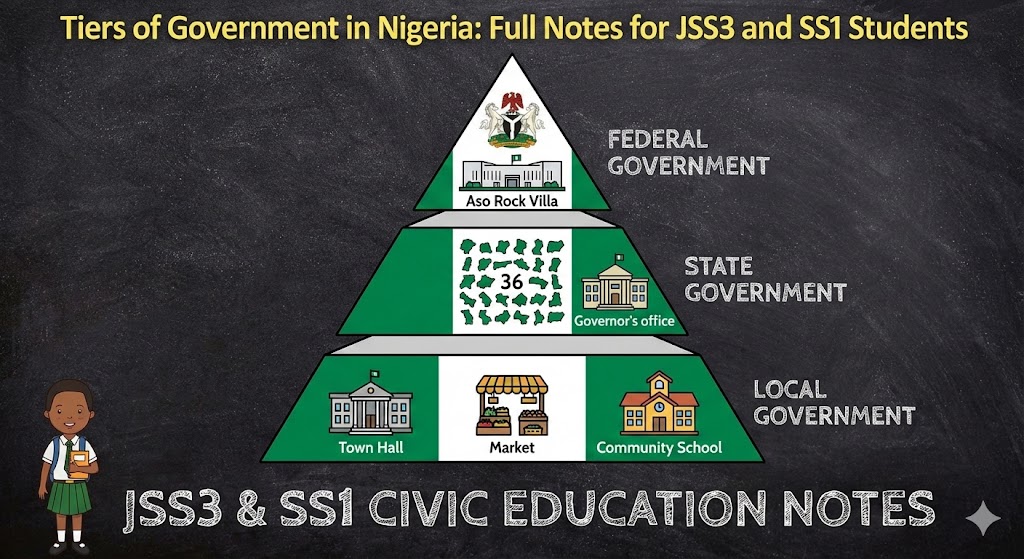
According to the Constitution of the Federal Republic of Nigeria, there are three distinct levels of government.
The Federal Government
The Federal Government is the supreme and highest level of authority in the country. It is the central body that coordinates the affairs of the entire nation. Headed by the President (currently from the Aso Rock Villa in Abuja), this tier handles issues that affect every single Nigerian, regardless of their tribe or state.
Let’s be honest, this is the “Big Brother” of the system. Their decisions override others if there is a conflict in the exclusive legislative list.
The State Government
The State Government is the second level of authority that governs the specific affairs of the 36 states in Nigeria. It is headed by a Governor. While the Federal Government looks at the big picture, the State Government focuses on the development of its specific territory, from Lagos to Kano.
This tier acts as the bridge. They take resources from the center and try to apply them to their specific people.
The Local Government
The Local Government is the third and lowest level of government, often called the grassroots government. It is headed by a Chairman and is the closest tier to the people.
I always tell my students to think of this as the “First Aid Box” of governance. If you have a small issue in your street, you run to the Local Government first, not the President in Abuja. Their main job is to bring development to the doorsteps of the rural populace.
Functions of the Federal Government
The Federal Government handles the heavy lifting—matters that are too big for a state to handle alone. These are often found in the Exclusive Legislative List.
-
National Defence: Protecting the country from external attacks (Army, Navy, Air Force).
-
Currency Issuance: Printing the Naira notes we spend.
-
External Affairs: Managing Nigeria’s relationship with countries like the USA or Ghana.
-
Immigration: issuing International Passports and visas.
-
Aviation: Controlling the airports and airspace.
Functions of the State Government
The State Government handles duties that require closer supervision than Abuja can provide. These often fall under the Concurrent Legislative List.
-
Education: Managing secondary schools and state universities (like LASU or OOU).
-
Healthcare: Running General Hospitals and state clinics.
-
Agriculture: Promoting farming programs within the state.
-
Road Construction: Building and maintaining Trunk B roads (roads linking major towns within the state).
Functions of the Local Government
The Local Government handles the day-to-day needs of the community. If you see a market being built or a street being named, that is their job.
-
Market Maintenance: Building stalls and keeping markets clean.
-
Birth and Death Registration: Issuing certificates when a baby is born.
-
Primary Education: Paying primary school teachers and maintaining the buildings.
-
Sanitation: Clearing gutters and disposing of refuse.
-
Naming Streets: Assigning names to streets and numbering houses.
Relationship Between the Tiers of Government
The relationship between these three levels is defined by the Constitution to avoid fighting. We call this “Revenue Allocation” and “Legislative Lists.”
The Federal Government gives a monthly allowance (allocation) to the States and Local Governments from the national cake (crude oil money). Without this money, most states would collapse. Also, the Federal Government can check the State Government to ensure they aren’t breaking national laws. It is a relationship of dependency and cooperation.
Problems Facing Local Governments in Nigeria
Despite their importance, the Local Government system in Nigeria is suffering.
-
Lack of Autonomy: State Governors often interfere with their funds and decisions.
-
Inadequate Finance: The money they get from the Federation Account is rarely enough to fix the roads and schools.
-
Corruption: Let’s face the truth—some Chairmen pocket the money meant for boreholes and grading roads.
-
Unqualified Personnel: Sometimes, the people hired are political thugs rather than trained administrators.
Modern Challenges in Governance
This section is for those of you who want to score extra marks in your theory. Examiners love it when you mention current realities.
One major modern challenge is the fight for Local Government Autonomy. Recently, the Supreme Court ruled that Local Governments should receive their money directly from the Federal Government, bypassing the State Governors. This is a massive shift. Previously, Governors used the “Joint State and Local Government Account” to hold onto funds. Understanding this recent change shows the examiner you are not just memorizing notes, but you actually understand Nigerian politics.
Conclusion
Understanding the tiers of government is simple if you remember the analogies. Federal is the Principal, State is the Teacher, Local is the Class Captain.
Read through these notes again before your exam. Focus on the functions, because that is where they will try to trick you in the objective questions. Good luck, and go make your parents proud.